Beyond the Door is a short film, based on a short story of
Philip K. Dick, made with the help of a very talented crew in early 2014. This post explains the evolution.
The story begins with the screenwriting forum,
The Black Board, which supports
Scott Myers' Go Into The Story blog and the
Black List. The BB is a online place where screenwriters meet and talk about films and writing and the screenwriting business.
John Muth and I were both involved with the BB, and there we (virtually) met. John and I figured out via the BB that we actually live relatively close to each other, yet for one reason or another never met.
The BB has a thread on
generating story concepts, which led me to a search for
interesting science fictions stories in the public domain. That's when I found this:
a short called
Beyond the Door, by Philip K. Dick. As I think of myself as a beginning student in screenwriting, I assigned an exercise to myself to adapt the story into a script. I quickly wrote a script adaptation and set it aside. Wanting a project to focus on over the winter break, I emailed John asking for advice. He replied very generously offering help, which I jumped at. When I mentioned this adaptation to John Muth as a potential joint project, he loved the idea. I sent him my script, which was about 10 pages. He (politely) tore it apart. I liked his suggestions and rewrote it, and script improved. One thing he talked me out of, and I'm glad he did, was treating Doris as a femme-fatale trope from film-noir. (This perspective on the short story was done already anyway: see Matthew Mandarano's
Beyond the Door) This tearing-apart-and-rebuilding process went through numerous iterations, but in the end we have a script that we both feel good about. We met twice to discuss the script and possible test shots during the first week of December, once at my house, where we will be shooting in mid-January 2014, and once at the
West restaurant in Annapolis, with some people involved with the
Annapolis Film Festival.
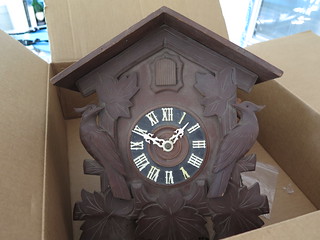
Regarding locations and props, I bought this (non-working) cuckoo clock at the
Boonsboro (Maryland) Clock Company, owned and operated by Dave Myers:
The cuckoo comes out of the clock by moving a lever inside the framework of the clock, as this
short clip shows.
I made several very crude storyboards
It turns out for various reasons, the seating arrangement with Larry and Doris at the table didn't work, so we switched it so they were sitting together. Most of the other storyboards were used in the finished version.
2013-12-22: great news - I heard from several very talented actors that they are interested in parts in the short. Both Dann Alagna and Jarrett Erwin expressed interest in playing Larry or Bob. Kat McKerrow and Ann Turiano have expressed interest in Doris. (I met Dann and Jarrett and Ann via Liza Skinner. In fact, Liza contacted Dann for me. Dann is a founding member of the acting/improv group Free Range Improv, which Liza belongs to. Liza and Ann are both teachers at the Compass Rose Theater. Kat I know from her performance as Prospero in the Laural Mill performance of The Tempest. Her husband Josh McKerrow directed it and I worked for him as the lighting tech.)
2013-12-24: I wrote up a "production script" detailing about 80 or 90 camera set-ups, and did some test clips, such as
this one with the cuckoo clock. I also compiled a props list:
- cuckoo clock (I bought 2, and an extra cuckoo big for extreme close ups),
- box and wrapping and tissue paper for clock present,
- stethoscope, latext gloves and lab coat and body bag for coroner,
- framed photo of Larry and Doris and child,
- framed photo of Larry and Doris and bird,
- robe for Doris,
- jacket for Bob,
- empty alcohol bottles,
- hammer,
- actors' wardrobe/makeup.
2014-01-02: We had our first rehearsal and it went great.
I'm closest to the camera, then to my left is Jarett Ervin, then Dann Alagna, John Muth, Kat McKerrow, Ann Turiano. The kitty Jeeves is on the floor trying to get attention from someone, anyone. I also did some more test clips, such as
this one with Kat McKerrow.
Here is a shot of Larry and the cuckoo:
Our next rehearsal is on the 12th.
I made it clear to the actors that I view the director as no more important than the actors. Sort of like a stage director with a camera. If they have ideas on whether a line should change, or a blocking sequence should be redone, or whether a certain action takes place before or after another, we will try it. This was a team project. They did have several such suggestions and they definitely helped improve the film, thanks to their ideas.
Cast and crew:
- Actors:
- Larry: Dann Alagna
- Doris: Kat McKerrow
- Bob: Jarrett Ervin
- Coroner: Ann Turiano
- Writers: David Joyner and John Muth (based on a public domain story by P. K. Dick)
- Producers: Liza Skinner, John Muth, Elva Joyner
- lighting assistant: Charlie Graf
- assistant production supervisor: Roland McKerrow
- production assistants: Elva Joyner, Ann Turiano, Dann Alagna
- Director, Editor, Cinematographer: David Joyner
Books I've enjoyed looking at while in the pre-production/principal photography/post-production process:
- Dan Gurskis, The short screenplay, Thompson, 2007.
- Steven Katz, Film directing shot by shot, Michael Weiss Productions, 1991.
- Bruce Block, Visual story (2nd ed.), Focal Press, 2008.
- Jeremy Vineyard, Setting up your shots (2nd ed.), Michael Weiss Productions, 2008.
2014-01-12: We had our second rehearsal and it also went great. Ann and John couldn't make it. The actors decided they preffered to do a run through of all the scenes, even if the wardrobe was wrong and the time of day was wrong. (The porch we were shooting on has no curtains, and is wall-to-wall windows, so day could not pass for night.) We rehearsed for about 3 1/2 hours and quit. I then roughly assembled the shots, with "titles" used as transitions when lines or entire scenes were missed for the actors to view. In all, there were about 120 takes shot that day. Here are some screenshots:
The "real shoot" is next weekend, starting the night of the 18th.
2014-01-19: We are officially in post-production! Barring any re-shoots, I'll try to make all the footage already captured work and avoid re-shooting any scenes, if at all possible. A few hours before the shooting started, a photography friend Charlie Graf helped me set up lighting for the green screen shots, but he had to leave before the actors showed up. The actor playing Doris came down with a virus but agreed to show up anyway for the final scene, which involves all the actors and was difficult to schedule. However, we had to cancel the shoot planned for the 19th. Kat brought her beautiful baby Roland, which my wife Elva kindly sat with to keep him company. Jarrett and Kat left as soon as we shot their scenes. With Ann's help behind the scenes, Dann and I worked late, getting all his solo scenes shot. As usual, it was fun working with all of them but I was exhausted by the time we finally quit shooting.
In all, there were about 90 takes shot that day. The total amount of raw footage was about 25 G, and the total time shooting was about 9 hours. The video from previous week's rehearsal was extremely helpful. Elva spotted lots of problems which helped in the editing (e.g., a mirror catching someone, such as me, that wasn't supposed to be in the shot). Going through the footage from the 18th, I see even more mistakes like that. Hopefully, they are fixable with some extra post-production work. Some shots from the final scene:
From now on, it is working with FCPX, and keeping my fingers crossed:-)
In addition to the
script written with John Muth, I started a notebook with more detailed shot descriptions (90 or so in all), and more crude storyboards. I also wrote two drafts of a "production script", the latest of which is
here. I decided to interweave into the story the (excellent) 1950 film noir
D.O.A., directed by Rudolph Mate which is now in the public domain (in the U.S.).
2014-01-21: I now have the video down to 10:30, not including the end credits.
2014-01-23: After 15 versions of edits, I now have the video down to 9:30, including the end credits.
I'll post the video publicly as soon as I can. I want to submit it to film festivals and am still researching the submission "premiere requirement" criteria for them.
The short is now on imdb: www.imdb.com/title/tt3486714/.
2014-03-12: I learned by email that the short was accepted at the Maryland International Film Festival!
All thanks to my great actors!
2014-05-03: I'm back from the Maryland International Film Festival. A few pics:
- Opening night - Peter Breitmayer (actor) and Nathan Marshall (director) of the wonderful and funny Coffee, Kill Boss:
- More of the opening night, with a Coffee, Kill Boss Q+A on the main stage:
- Daniel Herman (of The Backseat) and Sanj Surati and John Iwasz (of Zombie Casserole), at the Academy Theater on Saturday afternoon, when Beyond the Door was also shown:
More are at this
MDIFF flickr album.