When I think of Alfred Hitchcock's North by Northwest (1959), I think of the iconic set pieces (the crop duster chase, the Mount Rushmore scenes, Cary Grant's brilliant performance, but also the screenplay, written with Hitchcock’s occasional feedback, by Ernest Lehman.
Recently, in a commentary written for Turner Classic Movies, Guillermo del Toro calls it cinema's only flawless action movie:
North by Northwest, 1959 by Alfred Hitchcock, is a perfect perpetual motion machine and is made by one of the greatest clockwork makers in cinema history – a filmmaker that could blend seamlessly comedy, drama, action, and suspense. … This is one of the canonical films of Alfred Hitchcock, The most perfect action film ever made, in my opinion.
The film follows Roger Thornhill (Cary Grant), a suave yet hapless advertising executive who is mistaken for a government agent and is subsequently thrust into a web of espionage, deceit, and danger. Thornhill's journey—from a mistaken identity at the Plaza Hotel to the climax atop Mount Rushmore—is packed with twists, yet the pacing never feels overwhelming. Lehman’s transitions between action, comedy, and romance are seamless. Thornhill’s evolution from a complacent Madison Avenue executive to an unwilling yet capable hero is one of the screenplay’s greatest strengths. His transformation feels organic, propelled by Lehman’s writing, which keeps him grounded despite the extraordinary situations he faces.
While Hitchcock is the master of suspense, it was collaborating with Ernest Lehman that produced an entertaining thriller, as well as an example of how a well-structured screenplay can become the foundation for cinematic excellence.
By the way, as a writing exercise, I re-typed the screenplay for North by Northwest (as well as The Prize from 1963, Sabrina Faire, released as Sabrina in 1954, The Sweet Smell of Success, co-written with C. Odets in 1957, and Executive Suite from 1954). If you are interested in a pdf for scholarly purposes (e.g, you need to copy and paste into a scholarly article using the Fair Use clause), just send me an email. No promises that it is free from typographical errors (of my own), but the fountain files are also available, for making your own corrections.
Richard Matheson (1923-2013) is one of the most well-known of modern American writers. Matheson wrote novels and short stories in the genres science fiction, horror, fantasy, and suspense.
Many of his stories were adapted for film, such as "Twilight Zone" TV episodes (like "Nightmare at 20,000 Feet"), Steven Spielberg's "Duel" (1971) was based on his short story of the same title, "The Last Man on Earth" (1964) (two later adaptations were "The Omega Man" (1971) and "I Am Legend" (2007)), and "Legend of Hell House" (1973), based on his novel "Hell House" (1971).
Matheson also published, in 1954, a short screenplay, "The man who invented the world", which has lapsed into the public domain. In case anyone want to stage it as a play or shoot it as a short, I typed up the screenplay in standard format and posted it here: pdf, fountain. Download and best of luck! (For typos, please email me at fablestofilm@gmail.com.)
This film was written (story and screenplay) by William Rose and directed by Alexander Mackendrick (who also directed The Sweet Smell of Success, a film written by Ernest Lehman, also covered in this blog).
Scene-by-scene breakdown
Widow Mrs Wilberforce exits from her home on the edge of town. Her backyard looks over train tracks leading to a nearby train station. Walking through town, she greets townspeople, such as a beggar selling paintings and a street sweeper. She then goes to the police station to report a spaceship landing in her neighbor's yard. The Police Superintendent politely thanks her but, secretly, they think she is crazy. She leaves but forgets her umbrella. When a kind (fat) policeman reminds her, she says it’s old and she doesn’t like it but takes it with her.
She returns home, where she lives alone with her parrots. She's followed home by a man who seems to be a mysterious stranger he rings the doorbell and asks about her room to rent this is Professor Marcus he asked to move in and to practice music with his friends in his room she is delighted he then leaves
Marcus's friends arrive, four in total, all carrying musical instrument cases. They go upstairs to Marcus's room. They shut the door, put on a record of classical music and pretend to practice. Instead, they plot an armed robbery. They plan to have Mrs Wilberforce unwittingly help them get the money out of town.
Mrs Wilberforce knocks and the Gang comically gets set up to appear as though they have been practicing. They stop the record and answer the door. Mrs Wilberforce offers tea. When she leaves they argue about leaving her out of their plans after all. They take a vote. It turns out that one of them, the “muscular dumb” Lawson, indicates he likes Mrs Wilberforce. That swings the vote back to their original plan.
At the train station, Marcus spies on the movement of the money on the trains
Back at Mrs Wilberforce’s house, she knocks on Marcus's door and offers tea to his four remaining friends. Then she asked for help giving her bird it’s medicine. Mr Robinson (played by Peter Sellers) volunteers to help her with her bird. In a comical scene, he is bitten by the bird and the bird flies away. Mr Lawson agrees to help with the bird but he only makes things worse. It's a scene of slapstick comedy.
This is the robbery scene. Using a coordination of cars and trucks, the gang (1) blocks policeman from the armored truck, (2) take over the armored truck using guns, (3) knock out the two drivers of the truck, (4) pry open the back of the truck, (5) transfer the money into a large shipping crate (a 4 ft tall trunk). This trunk is taken away in their car
The getaway car with the trunk goes to the train station where Mr Robinson is disguised as a shipping clerk. He puts the trunk in with the other incoming crates and luggage.
The police actively search all over town for the robbery suspects.
Mrs Wilberforce unwittingly helps Marcus by collecting his trunk from the train station. He gave her the excuse that these are his books from Cambridge, but he will be unable to collect them. She leaves with the trunk but then returns to the train station because she forgot her umbrella. Again, she comments that she forgets it because it’s old and she doesn’t like it. She leaves again from the train station but stops in the street to help a horse being tormented by a man selling apples from his cart. A slapstick comedy scene involving policemen ensues. She then gets back in her car and the police help her deliver the trunk to her house
The Gang reunites at the house of Mrs Wilberforce and carry the trunk upstairs. The police do not suspect Mrs Wilberforce or Marcus's friends of putting the money in the trunk. As Marcus and his friends prepare to leave, on the way out Lawson gets his cello case stuck in the front door. As he yanks hard to free it, the case spills open and cash falls out. Mrs Wilburforce sees this and becomes suspicious.
The Gang rushes back inside and tries to convince Mrs Wilberforce that the money she saw was obtained legally. She doesn't believe their story. The doorbell rings and four of Mrs Wilberforce's friends arrive for a pre-scheduled tea party. These are all elderly women and are delighted to see Marcus and his friends there to join them in their tea party. Now Marcus and his friends don't know what to do – they can't kidnap all these women. One of the ladies invited over for tea has brought a newspaper. The newspaper informs them of all of the robbery and the amount of money stolen. Mrs Wilberforce now knows what Marcus and his friends have done. Without telling her tea party friends, she ushers the ladies all into the sitting room with the parrots. She then returns to the hallway to confront Marcus and his friends.
At this point Mrs Wilberforce, treats Marcus and his friends as though they are young children even though in fact they are older men. She tells Marcus and his friends that she is shocked and appalled at their behavior. They pretend to be ashamed and embarrassed at being caught. It is clear from her attitude she knows what they did but the robbery is never discussed explicitly. She explains to them that they must act like gentlemen and have tea with her friends. Lawson is especially impressed with her charm and grace.
Marcus and his friends enter the sitting room and have tea with the ladies and listen to one of the ladies sing a song.
The tea party over, the ladies have left, and Mrs Wilberforce confronts the Gang, again treating them again as little children. Marcus pretends to be ashamed and explains the money was insured and the bank doesn't want the money back. He explains the insurance company will simply distribute the cost of its loss throughout all of its customers, amounting to merely a farthing each. They tell Mrs Wilberforce a sad story of an invalid that the money is needed for. Mrs Wilberforce does not believe the story or at least says it doesn’t matter - it’s still wrong.
Before Lewis, the most violent of the friends of Marcus, can do anything the doorbell rings. The same (fat) policeman who returned Mrs Wilberforce’s forgotten umbrella at the station is at the door. (It is now night outside.) Before she answers the door, Marcus and his friends convince Mrs Wilberforce that the police will think she is involved with the robbery. She believes them and is worried what the police will think (as though they were her friends) will think of her. Marcus says to tell the policeman nothing and convince him to go away. She accepts this and so she answers the door in an unfriendly manner. The policeman just says that he wants to check in on her. She tells him to go away. The policeman is surprised at her gruff attitude but then leaves.
Again, she addresses Marcus and his friends and she insists that the money they stole be returned. They all get upset, but act ashamed. She says they should go to the police station and turn themselves in. She says if they don't she will go by herself and turn herself in.
Upstairs in Marcus's room with the door closed, the Gang discusses killing her. Mrs Wilberforce knocks and interrupts them saying they should go now to the police station. They say it's still raining outside and they will go when it stops raining. She agrees and leaves. Once Mrs Wilberforce is gone, Marcus and his friends draw straws for who should kill her (this is at approximately minute 63 of the 90 minute movie).
The Major, the kindest of Marcus' friends, draws the short straw but begs off the job of killing Mrs Wilberforce. Lewis, the most violent of them, threatens the major with a knife. So the Major is forced to go downstairs. He returns upstairs and tells them to tell Mrs Wilberforce that he wants to talk with her upstairs in their room. They all leave and Mrs Wilberforce comes upstairs. The Major tells her that he will go to the police and escapes out the upstairs window taking the money with him
The others discover that he is on the roof and chase after the Major. They catch him and recover the money but Mrs Wilberforce takes the money and locks it away in a storage trunk. Lewis kills the major without Mrs Wilberforce seeing that he's done this. Mrs Wilburforce goes to her sitting room and tells Marcus she's exhausted and will nap until the rain stops and the police arrive. She still thinks that the Major has gone to the police.
Marcus and the remaining Gang draw straws again to decide who will kill Mrs Wilberforce. However, Lawson refuses to comply and insists that no one hurt Mrs Wilberforce. Marcus tricks Lawson, who's not very bright, and tells him to go put the Major in a wheelbarrow so they can dispose of his body. Once Lawson leaves, the others draw straws and Mr Robinson gets the short straw.
Marcus and Lawson dispose of the Major by dumping his body into a passing empty train container as the trains pass through a tunnel going underneath Mrs Wilberforce's backyard.
Mr Robinson enters the sitting room where Mrs Wilberforce is sleeping. Instead of killing her, he sees the key to the trunk that she locked the money in. He takes the key, opens the trunk, steals the money, and escapes out the door.
Lawson returns and sees Mrs Wilberforce asleep but he thinks that she is dead. He's enraged that someone has killed Mrs Wilberforce. Afraid for his life, Lewis points to Mr Robinson who is running away outside. Lawson chases Mr Robinson down and kills him. The case with the money is left outside.
Lawson then runs inside to kill Marcus and Lewis but the noise awakens Mrs Wilberforce. Lawson, stunned that she is alive, stops attacking Marcus and Lewis. She asks where the cello case went. Lawson tells her that it is outside. He goes and gets the cello case with the money and gives it back to her. She puts it back in the sitting room.
Mrs Wilberforce is very disappointed with Marcus, again treating them as children. She returns to the sitting room to guard the cello case with all the money while she waits for the police.
Marcus, out in the hallway, privately whispers to Lawson to put Mr Robinson's body in the wheelbarrow to dispose of it, just as they disposed of the Major. Lawson refuses, saying he will stay with Mrs Wilberforce to protect her.
Mrs Wilburforce in the sitting room tells Lawson the story of her husband, who passed away many years ago at sea. She tells him that the parents that she keeps were his parrots. They remind her of her dead husband, who was a decent man. She wonders why the police are taking so long to arrive but then falls asleep for another nap.
Out in the hallway, Marcus and Lewis go out back to dispose of Mr Robinson in the wheelbarrow. While they are dumping Mr Robinson's body into an empty train container, they plot to kill Lawson and Mrs Wilberforce together. However, Lawson appears behind them and tells them he heard their entire conversation. He points to the gun that he holds in his hand and says “who looks stupid now?” then pulls the trigger to kill them. Nothing happens. The gun won’t fire.
Marcus and Lewis have killed Lawson and are disposing of his body. Lewis examines Lawson's gun and tells Marcus “he left his safety catch on” as they dump Lawson into an empty train container. The steam from the steam train engulfs them and Marcus escapes (knowing that Lewis wants to kill him to keep all the money for himself).
Lewis hunts for Marcus outside around the train station but Marcus has hidden behind some bushes. In this scene, they chase each other in the dark but eventually Marcus kills Lewis. A moment later a train signal falls on Marcus's head and he too dies.
Mrs Wilberforce awakes the next morning and goes to the police. She tells the police about the money and the robbery. They don't believe her. She asks what she should do with the money they say to keep it.
She walks through town. S gives the begger selling paintings a bill of money. It's so much he calls after her thinking she's made a mistake. She ignores him. She's very happy because now she has enough money to buy a new umbrella.
Ernest Lehman co-wrote the screenplay for Sabrina (1954) with Billy Wilder. The story is based on the 1953 play “Sabrina Fair” by Samuel A. Taylor.
There’s an anecdote that says that Wilder’s version of the screenplay diverged so much from the play that Taylor was fired due to his objections. It was at this point that Lehman, who had just written the excellent Executive Suite (also starring William Holden) was brought on. I don’t know how true that is.
Another anecdote says that Humphey Bogart was only brought on because Cary Grant was either unavailable or turned it down. In my opinion, Humphey Bogart’s subdued approach to the role is what makes the film work. William Holden, while excellent and perfectly cast, has an acting style too similar to Cary Grant’s. Humphey Bogart provides the perfect contrast to the part.
While similar in some ways to Wilder’s Love in the Afternoon (1957), this film is (IMHO) much much better. Clever twists and turns keep this screenplay moving. I’ve retyped the entire screenplay (the October 7,1953 draft of “Sabrina Fair” called “Final White Script”) in fountain. It is copyrighted and property of Paramount Studios, but if you would like a copy for educational purposes only, feel free to email me at fablestofilm AT gmail DOT com. Hopefully the study of the screenplay will encourage you to rewatch this terrific film.
One of Ernest Lehman's first jobs as a studio contract screenwriter for MGM was to first write a treatment for an adaption of a Cameroc Hawley novel of the same namen. Having suitably impressed the studio heads with that, he was then given the assignment to write the screenplay for the 1954 movie Executive Suite, starring William Holden and directed by Robert Wise.
The movie starts with the sudden death of the president of a furniture company, a man named Avery Bullard who we don't evey see (except for his hands). After Bullard's death, there is a struggle among the directors (the head of development, of production, of sales, the CFO, and so on) to succeed him. The protagonist is Don Walling (played by William Holden), the idealistic head of development. The antagonist is Loren Shaw (played by Fredric March), the over-confident CFO of the company. Sound boring? Actually, it's quite fascinating thanks to the excellent writing by Lehman and the fine acting (Nina Foch, who played Bullard's secretary, got an Academy Award nomination for Best Supporting Actress).
While the pdf is (as far as I know) not on the web, I bought a scan of the screenplay from Script City. To learn from Lehman's style, I typed the screenplay into fountain format. In the process, I learned something very interesting!
Lehman does do an excellent job of hiding exposition (as he should - see this earlier post). However, some of the exposition appears as a scene which lacks (for lack of a better word - pun intended) "emotional energy", such as the following.
EXT. PIKE STREET PLANT - DAY

Don walks through the gate to the sidewalk, on all
sides of him factory workers, anxious, depressed,
as they move towards lined-up buses, towards the
nearby parking lot, towards wives and children
waiting for them at the curb. Don looks up the
street, then turns and faces the building, atop
which is a flag at half-mast. As the men and women
stream by, they glance at Don with questioning,
worried expressions. Some of them greet him by name;
others nod or waves some look away, embarrassed.
An old Woman comes up to him, clutches his hand.

WOMAN
Mr Walling ...

DON
Hello, Liz ...

WOMAN
(anxiously)
Everything's going to be all right, isn't it?

Several workers stop to listen.

DON
(puts an arm around her shoulder)
Don't you worry about a thing...

WOMAN
You weren't here in Thirty-three. You don't know
how it was in Millburgh when Tredway shut down.

DON
(sees the faces watching him tensely)
Nobody's shutting anything down around here.
Mr. Bullard brought us a long way from *that*.

The workers glance at each other, then at Don,
with gratitude on their faces. They begin to scatter,
Liz the last to go. Don watches, deeply affected, as
the men are joined by their women and children, and
the family groups go off together by car and bus
and on foot.
I read the scene quite impressed with the importance and emotinal impact of the scene. (It helps to set-up an important point Don Walling argues towards the end of the film in his confrontation with Loren Shaw in the Director's Room. So, I think this scene counts as being expositional in nature.) However, I couldn't remember seeing the scene in my viewing of the movie. I actually assumed it must have been cut in the final version. (Actually, Robert Wise often worked with Ernest Lehman and rarely cut scenes from his screenplays.) However, I was wrong - it wasn't cut. This made me realize, I don't read scenes with the same engagement that I view them on screen. Why? What engages my brain in a viewing? The answer, I think, comes from something Mike Nichols (who BTW also worked with Lehman) said: every scene must be one of three things: (a) a fight, (b) a seduction, or (c) a negotiation. IMHO, the scene above is none of these.
This is why, IMHO, it lacks emotional energy on the screen.
By the way, there is a well-researched and well-written, biography of Ernest Lehman out now:
Plot Summary:
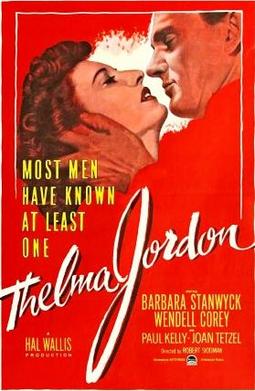
Thelma Jordon late one night shows up in the office of Assistant DA Cleve Marshall, who drinks due to a struggling marriage, with a story about prowlers and burglars. Before they know it, they are involved in a love affair. Thelma is also in love with a jewel thief, Tony Laredo, who has persuaded her to go live with her rich aunt, and steal her jewels. During the robbery, she shoots her aunt, but makes it look like an outside job. Through some clever manipulations by Thelma, Cleve is assigned the case and he maneuvers the state's case against her in such a manner that she wins an acquittal. But then Tony shows up. And nothing, from this point, works out well for Thelma, Cleve or Tony.
Why I Think This Is A Classic Movie:
This is a film noir in the style of the 1944 Billy Wilder film "Double Indemnity" (also starring Barbara Stanwyck as the femme fatale). However, in "Thelma Jordon" Stanwyck (the protag) takes on a more complicated character and there is more sympathy for Thelma's gullible "victim" (Cleve, antag who becomes an ally). While the plot has also been compared to de Toth's 1948 "Pitfall", the film is different from that as well. In Pitfall, Forbes (the protag, played by the hardboiled insurance agent Dick Powell) is similar in many ways to Cleve Marshall, and Mona Stevens (the antag, played by the excitement-loving, vivacious Liz Scott) is similar to Thelma Jordon, However, the sympathy in "Pitfall" is with Mona, while the sympathy in "Thelma Jordon" is with Cleve. It makes a big difference.
The talented cast and crew is another reason why this is a great movie:
Actors: The strong performances of Corey (as Cleve Marshall, gullible assistant DA) and Stanwyck (as Thelma Jordon, femme fatale) sell the story. They must construct for us sympathetic characters, so that Stanwyck's act of driving him to the brink of destruction (as well as her own resulting death) has emotional meaning for the audience.
Writers: Screenwriter Ketti Frings (1909 – 1981) was an American author, playwright, and screenwriter. Her novel "Hold Back the Dawn" was adapted by Billy Wilder and Charles Brackett into a 1941 film which was a Best Picture Academy Award-nominee. One of her plays was nominated for a Tony Award and won the Pulitzer Prize for Drama in 1958. Story writer "Marty Holland" is a pseudonym of Mary Hauenstein (1919-1971), a novelist who worked as a Hollywood script typist. Her other works include the novel for "Fallen Angel" (1945), directed by Otto Preminger.
Director: Robert Siodmak was a film director specializing in thrillers. He directed well over 50 films, including "The Killers" (1946), based on a story by Ernest Hemingway. While not in this case, he often teamed with his younger brother, Curt Siodmak, a novelist and prolific screenwriter (e.g.,The Wolf Man, 1941).
Cinematography: George Barnes (nominated 8 times for an Academy Award, winning for Hitchcock's Rebecca in 1940).
As Film Noir of the Week says in its review, this movie is an "underrated and currently grossly ignored gem."
My Favorite Moment In The Movie:
I love the scenes between Stanwyck and Corey. The one in the opening, when they are falling in love, are endearing and hook the viewer to want to see more.
My Favorite Dialogue In the Movie:
Thelma Jordon meets with her lawyer (Kingsley Willis, played by Stanley Ridges) in jail, at about the 1:02 point:
Willis: ... Marshall, on the other hand, we don't need to worry about.
Thelma: You thought all this up yourself?
Willis: No, to be honest. I give credit where credit is due. (pulls out a piece of paper.) From your Aunt Vera's friend, "Anonymous", the one who sent me $5000 to defend you. (Reads from the paper.) "Dear Mr Willis, a smart move would be to disqualify the district attorney by hiring his brother. ... " (burns paper with a match.) "Anonymous" has quite a grasp of things, don't you say?
Thelma: You did take the idea.
Willis: I like it. ...
Another quote, after Tony spies on her kissing Cleve (at around the 27 minute point):
Thelma Jordan: Tony, you scared me!
Tony Laredo: I didn’t mean to. I hate to be an eavesdropper.
Tony is a relatively minor supporting character but terrifying never-the-less.
Key Things You Should Look For When Watching This Movie:
Key scenes are: The Sun-room Scene between Thelma and Cleve (at about the 54-57 minute point) and the Car Scene between Thelma and Tony when she forces him to drive them off a cliff (at about the 1:33-1:35 point).
Movie Trivia:
(1) Stanwyck's original name was Ruby Catherine Stevens and her real-life older brother Malcolm Byron ("Bert") Stevens plays a defense aide in the courtroom scenes (at about the 1:08-1:25 point).
(2) The film is in the public domain and is legally available for free (at least in the U.S.) at: archive.org, and youtube
This post was first published in May 2015 at the great writing blog, Go into the Story, by Scott Myers. Check it out!
Writers:
Screenplay by Orson Welles
Based on a novel by "Whit Masterson" (the writing team, Robert Allison Wade and H. Bill Miller)
Lead Actors:
Charlton Heston
Janet Leigh
Orson Welles
Director:
Orson Welles
Plot Summary:
A stark, perverse story of murder, kidnapping, and police corruption in a Mexican border town.
Why I Think This Is A Classic 50s Movie:
Strong acting, outstanding direction, and precise camera work to elevate the tension, mark this film as one of the best films in the 1950s. Moreover, “Touch of Evil” is regarded as one of Welles' strongest films.
The movie has been studied extensively by film scholars, some who have
even called it the last of the great film noirs. Indeed, in addition
to many scholarly papers, there is an entire book only about this
movie: Terry Comito (ed.), “Touch of Evil, Orson Welles, director.”
Though the studio interfered with Welles' original editing, there is
now a version in which Welles' edits are restored by the renown editor
Walter Murch, based on Welles' 58 page memo.
The talented cast&crew is another reason why this is a great movie:
Welles has been voted the greatest film director of all time in numerous polls of industry professionals.
Charlton Heston (as the portag), Janet Leigh, and Orson Welles (as the antag) turn in strong performances.
The cinematographer Russell Metty won an Academy Award for Spartacus (1960).
My Favorite Moment In The Movie:
The very carefully scene of Quinlan (Welles) strangling Grandi (Tamiroff) in the hotel room with Susie Vargas (Leigh) in bed, drugged, is one of my favorites. The lighting and camera work are exceptional, adding to the intrigue and suspense.
My Favorite Dialogue In the Movie:
Janet Leigh has a lot of compelling dialog. For example, Grandi and
his henchman Pancho have lured Susie into his office
with an excuse that he has a message for her husband, Vargas. After a
long tense discussion with veiled threats, there is this:
SUSAN
Mr Grandi! You said you had something for my husband ... Don't
you think it's time you gave it to me?
GRANDI
I think it's time he goes back to Mexico City. That's advice. That's
what I got for him!
PANCHO
Shush --
GRANDI
Good night, Mrs Vargas.
SUSAN
Then the conference is over?
GRANDI
Eh?
SUSAN
I'm free to leave?
GRANDI
Free? Who said you weren't free? Nobody was holding you or keeping you
here, Mrs Vargas. Nobody's even laid a hand on you ... you were just
payin' a visit.
The final scene between Quinlan and Vargas is excellent:
VARGAS
Well, Captain, I'm afraid this is finally something you can't talk your way out of.
QUINLAN
...you killed him, Vargas.
VARGAS
Come on, now. Give me my gun back.
QUINLAN
...you killed Pete. The bullet is from your gun.
VARGAS
You think anyone would believe that?
QUINLAN
They always believe me. Anyway, they'll never believe I killed him.
VARGAS
The gun?
QUINLAN
You're resisting arrest.
VARGAS
How could you arrest me here? This is my country.
QUINLAN
This is where you're gonna die.
Key Things You Should Look For When Watching This Movie
The film opens with a 3:20 long tracking shot, one of the greatest long takes in cinema history.
Here it is on youtube:
This review was done in the style of the GITS series "Classic movies of the 1950s", but never appeared.
Here is a list of posts about all the public domain (in the USA) film noirs I know of. They vary in quality, but some are quite good. Many do not seem to be film noirs, but I used the classification at IMDB or archive.org. When there was a doubt, I included it. The only one I left out was "The Limping Man (1953)," starring Lloyd Bridges. Though I very much enjoyed it, it seemed to me more of a mystery/crime drama.
Director: Norman Foster
Writer: Sylvia Tate (story) , Alan Campbell, Norman Foster
Cinematographer: Hal Mohr
Plot: A man flees police after becoming an eyewitness to murder. He is pursued around scenic San Francisco by his wife, a reporter, the police, and the real murderer.
Director: Charles Guggenheim, John Stix
Writer: Richard T. Heffron
Cinematographer: Victor Duncan
Plot: "The St. Louis Bank Robbery" is dark story, based on an actual incident in 1953, about a bank robbery gone bad. An ex-college football star has decided to help his girlfriend's brother and some others with a bank robbery. The leader and planner is a psychotic.
Some classify this as simply a semi-documentary crime film.
Director: James V. Kern
Writter: James V. Kern (story), Mort Briskin, Robert Smith (screenplay)
Cinematographer: Hal Mohr
Plot:
A successful architect is tormented by the fact that his fiancée was killed in a mysterious accident on the night before their wedding. He meets a woman and they are immediately attracted to each other. She is quickly drawn into his strange dark world where things are not as they seem.
As of this date of this posting, the archive.org link directs you to a "There is an issue with this video's content" page. This indicates that the film may not be in the public domain. However, there are several versions still posted on youtube.
Director: Elia Kazan
Writer: Richard Murphy and Daniel Fuchs (adaptation), Edna Anhalt and Edward Anhalt (story), John Lee Mahin and Philip Yordan (uncredited)
Cinematographer: Joseph MacDonald
Plot: A doctor and a policeman in New Orleans have only 48 hours to locate a killer infected with pneumonic plague. It seems like a simple drama, but there is a gangster named Blackie (played by Jack Palance in his first screen role) who adds a noirish element.
Director: Peter Godfrey
Writer: Al C. Ward and Donald Hyde (screenplay), Ewald Andre Dupont and David T. Chantler (original story)
Cinematographer: Alan Stensvold
Plot: A lawyer wins an acquittal for his client, a woman accused of murder. After the verdict, he finds out that she indeed did commit the murder and manipulated him to win her acquittal.
Director: Phil Karlson
Writer: George Bruce and Harry Essex (screenplay), Harold Greene and Rowland Brown (story)
Cinematographer: George E. Diskant
Plot: An ex-con trying to go straight is framed for a million dollar armored car robbery and must go to Mexico in order to unmask the real culprits. John Rolfe is initially fingered for commiting a bank robbery. He is innocent and is soon released from questioning. Once released, he tracks down every one responsible until they are all dead. (Though only by the police, or their own in-fighting.) Additionally, he and the beautiful daughter of the police chief (who is also the mastermind of the crime) ultimately fall in love with each other. A "Hollywood ending."
Trivia:
Neville Brand was a highly decorated WW II veteran (Purple Heart, Silver Star, ...).
Jack Elam is famous for his western movies, where he played colorful off-beat characters.
Lee Van Cleef is also famous for his westerns (for example, "The Good, the Bad and the Ugly"). This was his 3rd film, of about 200 appearances in TV and film in his entire career.
Coleen Gray was also in Stanley Kubrick's "The Killing".
The original version of the video is (or was, last time I checked) the top film noir downloaded from archive.org. The quality of the download is very good, with very few pixelated frames.
Director: Max Nosseck
Writer: Sam Neuman and Nat Tanchuck
Cinematographer: Clark Ramsey
Plot: Paroled sociopath career criminal, while working at his brother's gas station, he becomes very interested in the armored car that makes regular stops at the bank across the street. He betrays his family's trust when he masterminds a complex armored car robbery.
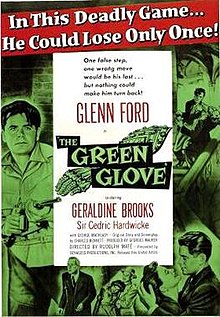
Director: Rudolph Mate
Writer: Charles Bennett
Cinematographer: Claude Renoir
Plot: An American paratrooper travels to France after the end of World War II to try to recover a jewel-encrusted glove that had been stolen from a country church during the war. Chasing him is a Nazi collaborator whom he had fought during the war. It was based on actions that took place during Operation Dragoon.
Question:
Is this "film noir" or "action/adventure"?
It might be film noir if the protagonist (the paratrooper character) or antagonist is, in fact, a twisted criminal. The way the film is directed and shot, down-plays this aspect. Stunning scenery and locations, even in black and white.