Showing posts with label 1940s. Show all posts

2023-05-11

The "Thin Man" series, according to AI

The Thin Man series is one of my favorites, so I thought I'd ask ChapGPT for a summary. It did a good job! I've added a few details but overall, AI really helped with this blog post.
"The Thin Man" is a classic detective comedy film series from the 1930s and 40s that features the husband-and-wife detective team of Nick and Nora Charles (played in each movie by William Powell and Myrna Loy). Here's a summary of each movie in the series:
  1. "The Thin Man" (1934): This film introduces Nick and Nora Charles, a witty and sophisticated couple who solve a murder mystery while drinking martinis and cracking jokes. Nick is a retired detective, and Nora is a wealthy socialite, and together they make a formidable team. The plot revolves around the disappearance of an eccentric inventor and the various suspects who may have wanted him dead. This one was based on the novel of the same name by Dashiell Hammett. Directed by W. S. Van Dyke, with a screenplay by husband and wife team Albert Hackett and Frances Goodrich.
  2. "After the Thin Man" (1936): In this sequel, Nick and Nora return to San Francisco after a trip to New York and find themselves embroiled in another murder case. The victim is a socialite with a troubled past, and the suspects include her former lovers and a gangster who may have been involved in her husband's murder. Once again, Nick and Nora use their charm and wit to uncover the truth. This was based on a story Dashiell Hammett. Again, it was directed by W. S. Van Dyke, with a screenplay by Albert Hackett and Frances Goodrich.
  3. "Another Thin Man" (1939): This film finds Nick and Nora in New York with their new son, Nick Jr. They become involved in a murder case when Nora's cousin is accused of killing her husband. The investigation leads them to a wealthy family with dark secrets and a dangerous gangster who may be connected to the crime. This also was based on a story Dashiell Hammett. Again, it was directed by W. S. Van Dyke, with a screenplay by Albert Hackett and Frances Goodrich, with Anita Looos also contributing to the screenplay (uncredited).
  4. "Shadow of the Thin Man" (1941): Nick and Nora are back in San Francisco, where they attend a baseball game and witness a murder in the stands. The victim is a jockey with a checkered past, and the suspects include his ex-wife, his former boss, and a group of gamblers. Nick and Nora use their wits and charm to unravel the mystery, with some help from their son Nick Jr. Again, this also was directed by W. S. Van Dyke. However, in this case the (original, except for the characters) screenplay was written by Harry Kurnitz and Irving Brecher.
  5. "The Thin Man Goes Home" (1945): In this installment, Nick and Nora travel to Nick's hometown in upstate New York for a family reunion. While there, Nick becomes embroiled in a murder case involving a wealthy art collector and his scheming family. Nora provides her usual support and wit as Nick tries to solve the case and clear his family's name. As W. S. Van Dyke passed away in 1943, a new director was used for this film. This one was directed by Richard Thorpe. The screenplay was written by Robert Riskin and Dwight Taylor, based on a story by Riskin and Harry Kurnitz.
  6. "Song of the Thin Man" (1947): In the final film of the series, Nick and Nora attend a jazz club and become involved in a murder case when one of the musicians is killed. The suspects include the victim's wife, his bandmates, and a wealthy socialite with a shady past. Nick and Nora work together to solve the case, with some help from their old friend Lieutenant Abrams. This one was directed by Edward Buzzell. The screenplay was written by Steve Fisher and Nat Perrin (with contributions by James O'Hanlon and Harry Crane), based on a story by Stanley Roberts.

2019-08-08

"His Girl Friday" (1940) and the Nutshell Technique

Recently, Jill Chamberlain wrote a book called "The nutshell technique: crack the secret of successful screenwriting" (link to her website). While I'm not yet done reading it, I like this book. As an exercise to understand this book, and to better delve into my favorite movie His Girl Friday (HGF), I wrote this post. Hope it helps someone out there.

Note:
  1. HGF is in the public domain, so you can read its script and watch it for free. I'm going to assume you've watched the movie in this post.
  2. Jill Chamberlain wrote a blog article describing Jordan Peele's Get Out using her Nutshell Technique. Check it out for more details on the method.

There are two flavors of the Nutshell Technique, one for Comedy (in the Aristotelean sense, where the protagonist gets what they want) and one for Tragedy (where the protag doesn't). We'll deal only with the comedy version in this post, since that's what HGF is.

The Nutshell Technique is a way to describe a feature film story using seven story elements which the protagonist (the main character that drives most of the action) has or experiences.

  • Flaw
    This is a weakness of the protagonist, a character trait which causes the protagonist to react negatively towards the "catch."

    In HGF, Hildy Johnson's "flaw" is her "external need" (in "the hero's journey" paradigm): she wants to be a conventional housewife, with a 9-to-5 husband, 3 kids and a house in the suburbs. As a result, she gets engaged to Bruce.

  • Point of no return (PONR)
    As with the "inciting incident" (in "the hero's journey" template of a screenplay) the PONR happens to the protagonist and is not an event created by the protagonists' actions. The PONR can occur after the inciting incident, but the PONR has to be connected with the SUW and the Catch (see below).

    In HGF, Hildy's PONR is her engagement followed immediately by the chance to write a newspaper article that saves someone's (the escaped convict) life. (One could also say, she got engaged and this immediately caused Walter Burns to interfere by giving her the article assignment. So the engagement is the PONR/inciting incident.)

  • Set-up want (SUW)
    In "the hero's journey", the "external want" of the protagonist motivates action until the midpoint, after which the "internal need" becomes more of a driving force.
    Here, the SUW is the protagonist's want that the PONR delivers to them; typically it corresponds to the internal need.

    In HGF, Hildy's SUW = internal need is to be great reporter, being thought of as an equal or better by the other newspapermen.

  • Catch
    This is a plot point something else delivered by the PONR but it is something the protagonist doesn't want. It's a counter-balance to the SUW and a test of the "flaw."

    In HGF, the catch is that Bruce's mom plans to live with them and interfere with the marriage.

  • Crisis
    This is the low point of the protagonist's arc (often marking the end of act 2). It is in some sense the worst thing that could happen to the protagonist, from the perspective of the SUW.

    In HGF, Hildy's crisis is when she and Walter Burns are both arrested by the Sheriff (for aiding an escaped criminal and kidnapping Bruce's mom), supporting the crooked Mayor.

  • Climactic choice
    This is a choice made by the protagonist which is counter-indicated by the FLAW. In "the hero's journey", it can be a choice determined by the "internal need," as opposed to the "external want."

    In HGF, Hildy's climactic choice is to ignore the objections of Bruce's mom and to pursue her newspaper article instead of following Bruce to the train station.

  • Final step
    This is a more emphatic choice made by the protagonist which is counter-indicated by the "flaw." It is a consequence, or at least dependent on, the climactic choice.

    In HGF, Hildy's final step is to reunite with Walter Burns and to return to work on the newspaper, but this time as the top reporter.

  • Strength
    The strength is the protagonist's characteristic that is achieved at the end of the character arc. It is a natural progression from the perspective of the climactic choice and the final step. In some sense, it is opposite to the "flaw."

    In HGF, Hildy's strength is that she is an independent woman, as capable or better than any man on the newspaper reporting staff.


2019-07-02

More lessons from the script for "His Girl Friday" (1940)

I've blogged before, here and also here, about one of my favorite films, His Girl Friday. This film, and its script, are in the public domain. The film screenplay was written by Charles Lederer, a friend of the great writer Ben Hecht, based on the play The Front Page, co-written by Hechtand Charles MacArthur (brother of "genius grant" creator, John D MacArthur).

The script and film largely tell the same story. However, the film changed some character names and also had a different (and better, IMHO) ending than the screenplay. Here is the list of characters:
  • Walter Burns (Cary Grant), head of a newspaper, once married to former newspaper reporter Hildy and still in love with her. He is the antagonist.
  • Hildegard "Hildy" Johnson (Rosalind Russell), once a newspaper reporter who worked for Burns. She is the protagonist.
  • Bruce Baldwin (Ralph Bellamy), Hildy's fiancee, who will give her all she thinks she wants - a house, a normal marriage, etc.
  • Mrs Baldwin (Alma Kruger), Bruce's mom
  • Duffy (Frank Orth), as assistant editor to Burns
  • Louie (Abner Biberman), a gangster friend of Burns
  • Earl Williams (John Qualen), a pitiful (mentally handicapped?) who's on death row, and the one Hildy is trying to save
  • Mollie Malloy (Helen Mack) a young woman who's taken pity on Earl, befriending him.
  • Mayor (Clarence Kolb), he uses Earl's executon to garner votes for his re-election.
  • Sheriff Hartwell (Gene Lockhart), the bumbling sheriff that allows Earl to escape.
  • Joe Pettibone (Billy Gilbert), the messanger carrying a reprieve from the governor, which the mayor and sheriff try to bribe to go away.
    (Pettibone is Pinkus in the script)
  • And several minor characters who play reporters:
    Porter Hall as Murphy,
    Ernest Truex as Bensinger,
    Cliff Edwards as Endicott,
    Roscoe Karns as McCue,
    Frank Jenks as Wilson, and
    Regis Toomey as Sanders (Sanders is Schwartz in the script?, if so, he's also a reporter).
    Pat West as Warden Cooley.
  • Edwin Maxwell as Dr. Eggelhoffer, psychiatrist who interviews Earl to see if he's crazy.
  • Marion Martin as Evangeline (the blonde girlfriend of Louis)

The script is available in various places on the internet as a pdf. It is worth studying. Threads to pay attention to:

  1. The camera directions add a visual feel. Note:
    1. These camera directions take a lot of space on the page, and are considered my many as excessive by today's script standards. Such directions usually are left to the director, besides taking up space on the page.
    2. Today, camera directions are sometimes included, but in an abbreviated fashion. For example, the original
      CLOSE SHOT OFFICE BOY as he bends over paper. We catch a glimpse of the squares of a crossword puzzle.
      
      might be rewritten today as
      OFFICE BOY (15) bends over the crossword puzzle page in a newspaper.
  2. The actor parentheticals add a blocking/physical feel.
    Note:
    These actor directions are considered as excessive by today's script standards. These are usually dropped altogether, but if they are included they're sometimes given in an action line. For instance
    HILDY 
        (with a smile) 
       Hello, Skinny. Remember me?
    
    would simply be
    HILDY 
       Hello, Skinny. Remember me?
    
    Perhaps her happy demeanor would be indicated during her character introduction. But
    WILLIAMS 
         (putting out hand to stroke her hair)
       Don't cry, Mollie, there's nothing to cry about.
    
    might be rewritten today as
    Williams puts out his hand to stroke Molly's hair. 
                 WILLIAMS 
       Don't cry, Mollie, there's nothing
       to cry about.
    
    Usually parentheticals are reserved for tone, eg, if a line is to be read sarcastically. However, one modern script with lots of parentheticals is the script for Saw (2004, written by Wan and Whanell and available online).
  3. The changing dynamic between what Hildy wants externally (husband, house, kids) and what Hildy needs internally (to make a difference, to be respected, to be independent as a professional).
  4. Keep an eye on the dynamic between Walter Burns and Bruce Baldwin, Hildy's two love interests in the story. Observe how their different personalities represent Hildy's different wants. (Energetic, driven and self-confident Burns connects to her internal want of being a good reporter. Shy, legalistic, and conservative Bruce connects to her external want of wanting a stable home and family.)
  5. Pay attention to the changing romantic connection between Hildy and Bruce vs Hildy and Burns.
  6. The lack of "intercuts" wastes a lot of space on the page in the phone conversations between Hildy and Burns. (The others are covered as a one-way dialog, but they involved minor characters.)

Here is a plot summary, based on the script.

A scene of a busy newsroom, one end an elevator and stairs, the other end the windowed-off office of the managing editor, and inbetween a bullpen of activity (called the "City Room"):
* telephone switchboard operators,
* office boys running errands,
* reporters in a hurry.

The elevator doors open and Hildy emerges with her fiancee Bruce. She greets the office boys and operators with a friendly smile and kind words. Bruce is sweet towards Hildy, then she leaves him to wait while she talks to Walter. In her walk along the length of the City Room, the greetings she receives makes it clear she is much loved.

The first scene between Burns and Hildy. They are much more alike than Hildy and Bruce. Burns and Hildy are both fast-talking, tough-minded reporters, with a nose for news. We learn they were once married and that Burns is bothered by the fact that Earl Williams (a criminal with some sympathetic aspects) is to be executed tomorrow. Then they start to bicker over things Burns did that caused Hildy to divorce him (not taking his marriage seriously - allowing the newspaper to take precedence, a curtailed honeymoon, no house that he promised her, etc). Hildy wants him to stop "phoning me a dozen times a day -- sending twenty telegrams ...". Burns wants to get married again.

More wonderful banter. Hildy's insistent she won't return. Burns makes up a lie that Sweeney won't be a work today since his wife is delivering a baby. He begs her to come back to work and offers a raise. She reveals that she's engaged, and to be married tomorrow. She wants to quit the newspaper business. He says she'll be unhappy doing anything else. Burns insists on meeting Bruce.

Burns and Hildy walk the length of the City Room, everyone's quit listening to their banter. Burns whispers to an operator to have his assistant editor call him in the restaurant in 20 minutes. As Hildy’s about to introduce Burns to Bruce, Burns intentionally mistakes Bruce with an elderly office “boy”, profusely flattering him. When Bruce tries to tell Burns that he is the real Bruce, Burns gets rude. When Burns recognizes the real Bruce he insults him snidely and insists on taking Hildy and Bruce to lunch.

At the restaurant, Hildy is warmly greeted by the staff. Burns asks Bruce about the wedding. It’s revealed that his mother will join them and Mom with live with them for the first year. Burns is called away to the phone booth. There he tells the newspaper than Hildy is returning. He returns to the table and fakes being crushed by sudden bad news about his reporter Sweeney. He tries to convince Hildy to help him out this afternoon to help write an article what Sweeney was supposed to write. She refuses. Burns says if she’ll help him, he will buy a $100000 life insurance policy from Bruce. She agrees, with Bruce’s encouragement, provided that it is paid with a certified check.

In the press room of the criminal courts building, reporters are playing cards while waiting for court news. There is a bank of phones at one end of the room for them to use once something happens. They are especially interested in the Earl Williams case, where he may get the death sentence carried out. Hildy enters. They all greet her warmly. "No, I'm not back for good. I'm just covering the Earl Williams story for Mr. Sweeney who had a sudden attack of something but will be all right by tomorrow. No, I haven't made up with Walter Burns...." She learns by talking to the reporters that Williams is delusional and hid out at Molly Molloy. The Mayor orders him arrested. The cop that arrives is killed by Early because he (in his delusional state) assumed he was there to murder him.

Hildy learns that a new psychiatrist (called an "alienist" in the script), Dr. Max J. Egelhoffer, is going to interview Williams. The execution by hanging is creating a big controversy (told in a darkly humorous way by the reporters).

Burns and Bruce have a discussion of the life insurance policy. Burns still loves Hildy and wants her to be his beneficiary of his policy.

On the phone, Hildy warns Bruce not to put the certified check in his wallet, but to put it in his hat instead. (She knows Louis can pick his pocket.) Louis follows Bruce anyway and scams a cop to arrest Bruce claiming Bruce stole his (Louis') watch. Bruce goes to jail, but at least he keeps his hat.

Hildy interviews Earl Williams in his jail cell. He believes the Golden Rule means to "do away with the profit system and have production for use only. There's enough food and clothing and shelter for everybody if we'd use some sense. ... Food was meant to be eaten, not stored away in restaurants while poor people starved; clothing was meant to be worn, not piled up in stores while people went naked." In this way, Hildy established that he lacks the ability to understand the consequences of his actions. Hildy then asks "Is that how you came to shoot the policeman?" Earl answers "Sure. You see, I'd never had a gun in my hand before and I didn't know what to do with it. Well, when I get stuck, I know that there's an answer for everything in production for use. So it came to me in a flash: what's a gun for? To shoot! So I shot. Simple isn't it?"

Back in the press room of the courthouse, Mollie Malloy shows up to berate the reporters for their slanders against Earl. She says "I never said I loved Earl Williams and was willing to marry him on the gallows! You made that up!" Hildy shows up and starts typing up her interview with Earl. Finally, Hildy says "Come on, Mollie. This is no place for you" leading Mollie toward door. Mollie says "They're not human!" Hildy says "They're newspaper men, Mollie. They can't help themselves. The Lord made them that way."

Mollie and Hildy leave together. Bruce calls for her. When she returns she speaks to him and learns he's in jail. She goes to the jail. Convinces the police lieutenant in charge to release him, or else "the Post will run the story of that roulette game on 43rd Street that you brother-in-law runs." The LT lets Bruce out. Bruce tells Hildy he lost his wallet but has his hat.

Hildy and Bruce go back to the press room in a cab. Hildy leaves Bruce in the cab, intent on finishing the interview, then taking the cab directly to the train. Hildy goes back to the press room by herself, types up the interview then takes it to the phone, asks for Burns, and tears it up over the phone. "ear that? That's the interview I wrote... Yes, I know we made a bargain. I just said I'd write it -- I didn't say I wouldn't tear it up." She hangs up.

Earl Williams is being questions by the incompetent Dr Egelhoffer and the Sheriff. Earl escapes just as Hildy is about to storm out of the press room. The reporters rush to the window to watch police search for Earl, gunshots being clearly heard, some even hitting the windows of the press room. Each reporter quickly calls his newspaper, sends in a report by phone, then leaves the press room (presumably to watch the action on the street).

Hildy calls Burns backs and tells him the news about Earl's escape an that she's back on the job. Hildy runs downstairs and corners Cooley, a policeman who witnessed the escape. Hildy brides Cooley (with 450 dollars) to tells her how Earl escaped. Colley agrees.

Reports return to the press room, including Hildy. Some file more reports but they don't know how Earl got his gun. Hildy does (but it hasn't been yet revealed to the audience). They ask Hildy how Earl escaped and she jokingly says "the Sheriff let him out so's he could vote for him." More machine gun fire downstairs and the reporters rush out of the room again. Hildy and Burns have a phone conversation taking 3 pages (at the time, intercuts were not used). We learn that "The Sheriff gave his gun to the Professor, the Professor gave it to Earl, and Earl gave it right back to the Professor -- right in the stomach! Who? No, Egelhoffer wasn't hurt badly. They took him to the County Hospital where they're afraid he'll recover." Burns promises to join her there in the press room. She tells him to hurry, as Bruce is downstairs in a cab. Burns hangs up and tells Louis and his blonde girlfriend to play a trick on Bruce in the cab.

A reporter comes in and files another report by phone. Hildy gets another phone call from Bruce, in jail again. Hildy rushes out again to help get Bruce out of jail.

The Mayor enters the press room looking for Sheriff Hartman. Hartman enters and tells the reporters how to find Earl (at Mollie's). They all run out, leaving the Mayor and Sheriff alone. Another reporter enters and makes fun of both of them, also making clear that the Governor doesn't like the Mayor and conversely, files a report then leaves.

Mayor and Sheriff leave to find a more private room to discuss something important. They go to Sheriff's office and agree that if they don't hang Earl, they will lose the upcoming election. A messenger Pinkus (Pettibone in the film) comes to tell them that Earl has a reprieve from the Governor. The Mayor bribes Pinkus to leave, to return the next day, hoping he can capture Earl before Pinkus returns.

Hildy is in the press room when Louis shows up with $450 in counterfeit bills. She also demands Louis returns Bruce's wallet, which he does then leaves. Hildy is alone when Earl crawls through the window. She gets the gun from him and calls Burns, telling him to hurry over. She gets a call from Bruce and asks him to wait more. Bruce hangs up on her. Mollie shows up and gives Earl moral support.

The reporters want to get in but the door is locked. Hildy hides Earl in the rolltop desk. She asks Mollie to pretend to have fainted, as a distraction. Mollie lays does, closes her eyes and Hildy unlocks the door. Mrs Bardwin (Bruce's mom) shows up and berates Bruce. Mollie recovers and the reporters grill her so heatedly she goes crazy and jumps out the window (Mollie doesn't die). Mrs Baldwin faints. Burns arrives and Mrs Baldwin recovers, very upset. Burns tells Louis to take her out of the room. Burns talks Hildy into focusing on the story and to ignore Bruce for the moment. Hildy begins typing up the story furiously.

Bruce shows up, having been released from jail again. (He bailed himself out.) She keeps typing. Bruce asks for the money she owes him. She gives him $450 (in counterfeit bills), as well as his wallet. He tells her he's going on the 9pm train and tells her to meet him there. Bruce leaves. Burns and Hildy lock the door again. A reporter shows up, demanding to be let in. Burns offers him a job at his paper, tells him to go talk to Duffy right away. Reporter leaves. Burns calls Duffy and tells him to "Stall him along until the extra comes out." Hildy finished her article. Burns kisses her.

Louis returns, says his cab crashed into a police car and he lost Mrs Baldwin. The implication is that Mrs Baldwin is dead. Hildy wonders how she will tell that to Bruce. Burns tells Louis to get some men to haul the desk with Earl in it out of there. Having called the local hospitals with no luck, Hildy gets ready to leave to search for Mrs Baldwin.

The Sheriff shows up with the reporters and demand that Hildy tell them where Earl is. He's about to arrest Hildy and Burns and confiscate the desk when Mrs Baldwin enters, with two deputies. Bruce is there as well, but she has him stay outside the press room. Mrs Baldwin and Burns argue over who kidnapped her. Burns insults her and she leaves. The Sheriff discovers Earl hiding in the desk, then takes him out. The reporters all run for their phone and file a report. The Sheriff returns and puts Burns and Hildy in handcuffs.

Pinkus returns, drunk, and mentions the reprieve to Burns and Hildy and the bride the Mayor gave him. Burns and Hildy use this information to get the Sheriff to release them.

Burns reminds her that Bruce is expecting to meet Hildy at the train station to take the 9pm train and that he (Burns) promised she'd be there. Burns asks Hildy to stay another hour to finish the article, telling her she can make the 10pm train instead. Conflcted, she flips a coin: Heads she goes, tails she stays to write the story. She stays and wires Bruce to call off their engagement. Burns proposes again. She excepts (under pressure from Louis, who kidnaps a judge to perform their marriage ceremony.

After they are married, Hildy learns that Bruce has been arrested again, this time for passing counterfiet money (the money Burns gave him via Louis). As she chases Burns around the table, Louis has the last line, said to the judge: "I think it's going to work out all right this time." (This is not the ending of the movie.)


2016-03-01

"His Girl Friday" (1940) with script - first 4 pages

I've written before on one of my favorite films, "His Girl Friday," arguably the best film in the public domain.

For fun, I decided to see how badly the "one minute per page rule" fails for this film. The first four pages take approximately 2 minutes of film. It's fun to see the small changes here and there and the how Howard Hawkes followed the directions. Starting on page 5 there is a long divergence away from the script. Makes things interesting!

2015-12-29

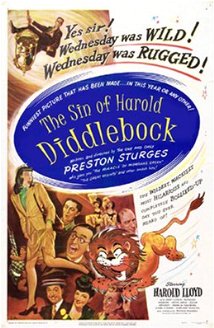
"The Sin of Harold Diddlebock" review

The Sin of Harold Diddlebock (also released as "Mad Wednesday") is a 1947 film written and directed by the great Preston Sturges. It starred Harold Lloyd, Jimmy Conlin and (in a small but important role) Frances Ramsden.

Plot Summary:

A madcap comedy following the ups and downs of Harold Diddlebock.

After scoring the winning touchdown for his college football team mild-mannered Harold Diddlebock (Harold Lloyd), gets a job offer from a football fanatic and business-owner, "Chief". For 22 years, Harold works a dull, dead-end book-keeping job for the man. The story begins with Harold being called into the Chief's office and being fired, with nothing but a tiny pension. Diddlebock bids farewell to the beautiful girl at the desk down the aisle, Miss Otis, whom he had hoped to marry - just as he had hoped to marry six of her older sisters before that. The depressed Diddlebock wanders aimlessly through the streets, his life's savings in hand, and falls in with a con-man Wormy (Jimmy Conlin). They go to a bar for a drink. When he tells the bartender that he's never had a drink in his life, Wormy has the barkeep create a potent cocktail he calls "The Diddlebock". One sip of this concoction is enough to release Diddlebock from all his inhibitions, setting him off on a day-and-a-half binge of spending and carousing. He awakes to find that he has a garish new wardrobe, a ten-gallon hat, a Hansom cab complete with driver, and ownership of a bankrupt circus. Trying to sell the circus to bank owners, Diddlebock and Wormy bring along Jackie the Lion (yes, a real lion, on a leash) to get past the bank guards and presumably to make the point that they do indeed own a circus. The lion incites panic and Diddlebock, Wormy and the lion end up on the ledge of a skyscraper. They are arrested and thrown in jail, but Miss Otis bails them out. Diddlebock learns that the publicity has attracted the Ringling Brothers, who bought their circus for $175,000. Miss Otis also tells him that they got married during his first drinking binge.

Why I Think This Is A Classic 40s Movie:

While not Sturges' greatest film, I think it is a classic due to its zany comedic plot ideas. It was nominated for Grand Prize at the Cannes Film Festival that same year. Harold Lloyd, in comic top form, was nominated for a best actor Golden Globe.

This film brought silent film star Harold Lloyd out of retirement, however, the two apparently had creative differences on set. This was a "collaboration" between Howard Hughes and Preston Sturges. They also had their differences. Hughes did not like the film and the copyright wasn't renewed. It is now in the public domain.

My Favorite Moment In The Movie:

I'm a sucker for sentimental but funny. Check out the film-ending scene with Harold Diddlebock and Miss Otis (now Mrs Diddlebock).


My Favorite Dialogue In the Movie: Harold Diddlebock bids farewell to Miss Otis.

Harold Diddlebock:
Miss Otis, I --

Miss Otis:
Yes, Mister Diddlebock.

Harold Diddlebock:
Miss Otis, when your eldest sister Hortence came to work here
seventeen or eighteen years ago, I fell in love with her. She ws a
lovely girl.

Miss Otis:
Yes, I know, I mean that you fell in love with her. She told me.

Harold Diddlebock:
Well, she swept me off my feet. My circumstances at that time did not permit even the contemplation of marriage.

Miss Otis:
Yes, I know, she told me.

Harold Diddlebock:
She very wisely stopped waiting for me and married the gentleman whose life she has illuminated. I felt that my own life had ended, that I would never love again. That the sunshine would withdraw permanently behind the clouds.

Miss Otis:
Yes, I know.

Harold Diddlebock:
But I was mistaken.

Miss Otis:
Of course.

Harold Diddlebock:
Because when your next eldest sister Ermine came to work here, I fell even more deeply in lve with her that I had with Hortence.

Miss Otis:
Yes, I know, she told me. Hortence even got a little burned about it.

Harold Diddlebock:
Well, she needed have because when Ermine, in her turn, got married she was replaced by your next eldest sister Harriet, I felt that everything that had gone before was merely an appetizer.

Miss Otis:
Yes, I know, she told me too.

Harold Diddlebock:
They were getting better and better. Your mother seemed to be making them nicer every year.

Miss Otis:
Thank you.

Harold Diddlebock:
I haven't come to you yet. ... When Harriet ran away with the head-stone salesman, I was inconsolable.

Miss Otis:
None of us felt very good about it.

Harold Diddlebock:
I was going to propose the very next day.

Miss Otis:
I didn't know that.

Harold Diddlebock:
I had the ring in my pocket. I just made the last payment on it. The one I started for Hortence.

Miss Otis:
You came so close.

Harold Diddlebock:
I never felt so defeated in my life. I never thought I'd smile again.

Miss Otis:
Then you met Margie.

Harold Diddlebock:
That's right. She was better than the others.

Miss Otis:
Mother had more practice.

Harold Diddlebock:
Practice makes perfect. By then, of course, I'd been wiped out in the market.

Miss Otis:
Oh, was that it? She never knew.

Harold Diddlebock:
That's right. I started to get on my feet again when your sister Claire came to work here.

Miss Otis:
Why didn't you ask her? Didn't you like her?

Harold Diddlebock:
Like her? I worshipped her. Only then, that irresponsible lout that married my sister choose that time to kick the bucket, er, pass on, without leaving even a dime's worth of insurance. So, I found myself with a ready-made family.

Miss Otis:
Poor Mister Diddlebock. I suppose you were in love with Rosemary too,
while she was here.

Harold Diddlebock:
Naturally. Of course, I was so in the habit of being in love with your mother's daughters that it would be impossible for me to even see one of them without ... without --

Miss Otis:
Without what, Mister Diddlebock?

Harold Diddlebock:
I presume you know I've adored you since the first morning you punched the time card. ... You knew it, didn't you?

Miss Otis:
Well, I suspected it. My sisters had warned me.

Harold Diddlebock:
Of course. Imagine being exposed to seven Miss Americas and muffing all seven of them.

Miss Otis:
Poor Mister Diddlebock.

Harold Diddlebock:
I'm leaving here today.

Miss Otis:
Oh no, Mister Diddlebock.

Harold Diddlebock:
That's what I really want to tell you. I don't know where I'm going and I very probably won't see you again. Why don't you just take this?

Harold Diddlebock hands Miss Otis a ring box.

Harold Diddlebock:
It's all paid for. Someday when you meet some young man who's really worthy of you, who has everything but the engagement ring, you can take that excuse away from him.

Harold Diddlebock shuffles out.


Key Things You Should Look For When Watching This Movie

The scene between Harold Diddlebock and Wormy when they first meet is brilliant. The final scene with Harold Diddlebock and Miss Otis (now Mrs Diddlebock) is funny and very touching. Look for Sturges' stock company of actors playing the minor roles.

This post also appeared as a guest post on September 2015 in Scott Myers' great Go Into the Story Blog. His blog is the best out there for screenwriting advice. Check it out!

2015-02-26

The Colmar Incident

The Colmar incident concerns a true episode in World War II which took place in and around Colmar, France, in which a top-secret cryptographic machine called a SIGABA (or an ECM Mark II) went missing. This event is now declassified and this blog post follows very closely a document published on the NSA website (author unknown). There is no originality here, but the story has the makings of a Hollywood movie and I only hope that this post is entertaining to others as well. Maybe a Hollywood scriptwriter!


caption: The ECM Mark II or SIGABA machine. source: wikipedia

The SIGABA machine was used during WWII by the US Army in its most highly classified operations. Unfortunately, it went missing around the time of the Yalta Conference, and allies were very concerned that the Nazi's had gotten a hold of the machine (Colmar is located in eastern France about 10 miles from the border with Germany).


caption: The Yalta Conference was held February 4-11, 1945, in the Black Sea, about 1500 miles east of Colmar.

The main duty to track down the machine was given to Army COL David Erskine, who, with Navy LT Grant Heilman, eventually found it in the Gresson River. This is the story of its recovery. Below, we follow almost verbatim the NSA document mentioned above [CI].


The Colmar Incident


Introduction


As the Allied armies were preparing for the final assault into Germany during the waning months of World War II, an event occurred which had the makings of a major disaster. An advancing U.S. Army division lost a SIGABA, the cryptographic machine used for the highest level of U.S. communications. This type of machine was a vital part of a world-wide combined (UK/US) communications system, and should it fall into enemy hands, the results could be devastating. All of the Allied war plans for the spring assault into Germany, for example, had been enciphered by SIGABA, as well as arrangements for President Roosevelt's pending trip
to Yalta. And it was the only highly secure U.S. cipher system available to many U.S. units in Europe at that time.

After news of the incident reached Arlington Hall, the most important question was whether the equipment had fallen into enemy hands. And, under wartime conditions, it had to be assumed, until proven otherwise, that the SIGABA machine had, in fact met this fate. As a consequence. there was a massive effort to fill this cryptographic void while the matter was being investigated. And the investigation itself, in addition to diverting men and equipment from the war effort, deeply involved persons at the highest levels of the U.S. and Allied governments and military establishments.


Events leading to the disappearance


On 6 February 1945, Headquarters, Communications Zone, European Theatre of Operations (Paris) dispatched an Urgent~Secret message to all strategic commands in Europe, informing their signal officers to suspend use of certain cryptographic systems and materials due to a possible compromise. An information copy of the message, which read as follows, was also sent to the War Department and Arlington Hall:


Suspend use immediately of editions 18 and 19, of systems 2201, 2222, and 2242, editions 10 and 11 of CCBP 0125 and 0126 and edition 2 of 514.

Grave possibility of compromise of all mentioned exists, all Commanders to be informed of possibility of enciphered traffic via radio in above systems being read by enemy. Reserve systems now being distributed.

Use only secure landline. courier, or reserve systems where available until security restored. Nets 12, 13. 14, 1S and 17 not affected as well as CCBP 0101, 0102, and 0103 by above. Inform all subordinate units concerned.

But it was not until 10 February, when the officer in charge of the War Department Code Center called persons at Arlington Hall to alert them that an extremely important message concerning the compromise had just been received, that any specific details became known concerning the systems involved in the compromise:


Parked truck belonging to two-eight infantry divisions containing following documents stolen in Colmar France: SIGABA, .... Use of all systems listed has been suspended in this theater and every possible action being taken to restore security. CCBP0131 has been distributed to all holders. Secure landline and courier being used in most cases. Full investigation of loss being made by Sixth Army Group. Will keep you informed of development and action taken.

A trans-Atlantic enciphered phone conversation on the 11th, between Arlington Hall Station and the Signal Intelligence Division, ETO, Paris, afforded additional information. It noted, among other things, that a 2.5-ton truck had been stolen from a city street in Colmar, France, containing the SIGABA and associated, and other, equipment and documents. It further noted that the SIGABA and these other materials were in a locked safe in the ``code room'' carried by the truck.


caption: A GMC 2 and a half ton US Army truck from WWII.

The theft involved the 28th Infantry Division, which was being transferred from Kayersburg, France, to the city of Colmar. Colmar had been evacuated by German troops several days before, and on the day of the theft the enemy was only about four miles to the north of the city.

The event had its beginning on 4 February, when the chief of the message center of the 28th Division's Signal company departed from Kayersburg, with an advance station of his cryptographic team and equipment, to set up a message center in Colmar. When the men arrived, they found there were no billets ready or even allocated to the signal company. Having found an unoccupied house at No. 16 Barbarassastrasse, and having obtained official permission to occupy it, they unloaded their cryptographic equipment and established communications.

The next day, 5 February, the second half of the team, with spare sets of cryptographic equipment, including a SIGABA, departed for Colmar. Upon arrival, the men located the first group. (Unfortunately, though the signal company's motor pool section, which had the responsibility for establishing a guarded truck park, had not yet arrived.) After locating the division's message center, which had been established by the advance party the day before, the men were told that their billets were at No. 16, and were instructed to park as near to the house as possible. Subsequently, the truck (with SIGABA and associated equipment) was parked for the night in front of No. 20 Barbarassastrasse, but without guards, as normally required.

The next morning, when two officers went to the truck, to make some repairs, it was gone. After reporting to the message center chief that the vehicle was missing, the two men began searching for the truck.

Note added: David Kahn (The Codebreakers, [K], page 510) gives another account: Two SIGABA guards parked the truck outside a brothel in Colmar on the evening of February 3 to visit some friendly ladies. When they emerged the truck was gone. One version of the story says these guards were sent to Leavenworth for the remainder of the war, and the pardoned later.

About 11:15a.m. they found the trailer to the truck abandoned on a dead-end road. Tire tracks at the scene indicated that the trailer had been unfastened, and the truck had been turned around and driven out of town. A quick inspection revealed nothing was missing from the trailer, which had contained only unclassified material.

G-2 (Intelligence staff) of the Division Headquarters in Colmar, coordinating with the Military Police, ordered a complete search of the area, and the Inspector General, 28th Division, ordered a thorough investigation of the responsible personnel. He also sought anyone who might have any information concerning the lost truck. This request had some results, revealing, among other things, that a radio car from the same company had been parked across the street from the 2.5-ton truck and that men of the company had made frequent trips to the car throughout the night, for the purpose of occasionally running the motor. However, these men had neither seen nor heard anything and, in fact, had taken no notice of the truck in question.

It was further directed that all units and divisions conduct officer-supervised searches to include all sheds, barns, woods, mountain areas, etc.. SHAEF (Note added: SHAEF - Supreme Headquarters, Allied Expeditionary Force - European Theater of Operation, General Eisenhower's Headquarters.) was also asked to conduct a complete theater-wide search and the Sixth Army Group directed all headquarters troops, and subordinate units as well, to inventory the motor numbers and inspect the content of all 2.5-ton trucks. Also, the help of the local police and the Surete Militaire (CIC's French counterpart) was promptly enlisted. Descriptions of the truck and safes, but not the contents, were given to the French officials. (American and British headquarters elements in Europe received more specific information about the contents of the truck.) General Eisenhower personally became involved and ordered that a vigorous investigation and search be made to locate the missing vehicle. With the possibility of the disclosure of all of the plans for the spring offensive, the Supreme Allied Commander in Europe gave top priority to the recovery of the truck containing the SIGABA; all Allied high commands participated in the search.

Note added: According to [K], Eisenhower ordered General Jacob L. Devers, commander of the 6th Army Group to find the missing safe(s). Devers assigned this to his chief intelligence officer Colonel David G. Erskine.


Crypto-equipment found


Extensive air and ground reconnaissance was conducted while motor and foot patrols continued their more intensive searches throughout the Sixth Army Group area during February and the early days of March. During this time, several reports of incidents involving the French came to light, casting suspicions that the culprits could very well be Frenchmen. One involved a truck, resembling the stolen 2.5-ton GMC, which had run through a road block at Montbilliard, 35 miles north of Colmar. On another occasion, on an overnight visit to Colmar, the Seventh Army's CIC Detachment had three jeeps stolen by French units. Also, as soon as it became known that Colmar was being occupied by Allied troops, French soldiers from various units not with the French and American divisions occupying the town, suddenly appeared on the scene and "appropriated''
whatever trucks and vehicles they could.

Although such activities strongly suggested that the French were involved with the theft, there was another equally suspicious - and far more ominous - possibility.

Because members of the 28th Division's signal company had been captured before 5 February by the Germans, the enemy could have known that such highly sensitive cryptographic material was in the Colmar area, and made a special effort to acquire it.

Although many reports continued to come in during February, the results were all negative. However, the vehicle inspections did turn up some enlightening facts. Stealing trucks from front-line positions was obviously common practice, as evidenced for example by the recovery of six 2.5-ton trucks found in the possession of the wrong units during the serial-number checks.

Four days later, on the morning of 9 March 1945, the truck was finally located, abandoned in a wooded area several miles north of the city of Rambervillers, approximately 45 miles northeast of Colmar. The bumpers of the truck had been removed, and the numbers had been painted out; otherwise, there was no other apparent damage to the truck. However, the safes containing the SIGABA and the other equipment were gone.

Later that same afternoon, a search party from the Deuxieme Bureau, II Corps, First French Army, discovered the upper half of the safe (designated SIGRINO, Chest CH-76), as well as a small company field safe, submerged in the Gressen River, a small mountain stream which runs between the towns of Chaenois and Scherweiller. The safes were immediately placed under guard and turned over to the Sixth Army Group. The upper half of the SIGRINO contained the SIGABA and other classified equipment. The lower half of the safe, which had not yet been recovered, contained instructions, pamphlets and rotors for the SIGABA.

Meanwhile, the search for the missing safe and equipment intensified. The river was dredged near the bridge where the first discovery had been made, and plans were even made to divert the water flow. Working on the suspicion that the safes were probably thrown into the river in early February, at a time when the water level was much higher, investigators theorized that the swift current would have carried them a little farther downstream. Therefore, river dredging efforts were concentrated a few yards downstream from the bridge.

While this operation continued, Headquarters, Sixth Army Group, began a thorough inspection of the recovered. equipment. The vital question was still whether the safes, rotors, and associated material could have been compromised. Fingerprinting and other investigative analyses were virtually impossible, because of the deteriorated condition of the mud·and-water-soaked equipment. However, after a thorough inspection, G-2 and Signal Intelligence decided that, since the settings in the safes had not been re-adjusted, and since there was no evidence suggesting that attempts had been made to open the safes, no compromise existed.

Note added: Examination proved that the rotors were set up in arrangement for 5 February. (This was, however. in violation of strict security rules for moving the machine, as rotors were never to be left in place when transporting such equipment.)

Finally, eleven days later, on 20 March, the lower safe was recovered from the river bottom about 100 feet downstream from the bridge.

Note added: The version of the story in [K] is similar: Erskine was joined by 2-star General Fay B. Prickett and Navy Lieutenant Grant Heilman. Based on a tip from a French source, Erskine and Heilman found the machine and safe(s) in a river.


source: Johnson [J]

Efforts to open the safe were unsuccessful because the combination was clogged with silt. Subsequently, the safe was sent to Paris where it was "opened'' at a "ceremony'' attended by at least half of the intelligence staff in Paris. Attempts were first made to open the safe with a torch, but, fortunately, the torch ran out of oxygen, after cutting about two inches, for when the safe was finally cut and drilled open later, long after the VIP guests had departed, it was found to contain two 55-pound thermite bombs and 14-pound blocks of TNT, all wired to detonators. It was also fortunate that these explosive had not been designed as a booby trap; they were simply the devices normally carried with cipher machines to destroy them if they were in danger of being captured by the enemy.


source: Johnson [J]

Suspects


Although no written records can be found regarding who had actually stolen the truck, an interview with an officer who was active in G-2 efforts at Headquarters, ETO, Paris, during the Colmar incident did uncover some interesting information. He stated that during the Inspector General's investigations, two French peasants commented that the American Government could find its truck in the "woods,'' and, further, that the "boxes'' in the truck had been thrown into the river. Although the woods and river were not identified by name, their description of the surrounding area was sufficient to permit the truck and equipment to be found and these two men were subsequently apprehended on the suspicion they participated in the theft. During their interrogation, however, it was learned from these Frenchmen that it, was actually their friend, a farmer, who had taken the truck to move his household furniture.

Note added: Kahn [K] relays a story told to Erskine that it was "borrowed'' by a French military chauffeur who lost his own truck. When the investigation started, he was afraid of getting caught, so dumped the boxes in a river.

The farmer's name was never disclosed by his friends; consequently, he was not apprehended for questioning. But in view of these revelations, the consensus at Sixth Army Group Headquarters was that the vehicle had been stolen for the value of the truck itself, and that the thieves were unaware that the truck contained highly valuable and sensitive cryptographic equipment.

Note added: According to Johnson [J], Erskine was awarded the Bronze Star and the Legion of Merit, and was eventually promoted to Chief of Staff for Intelligence for all the Army ground forces. He retired in 1952.


source: Johnson [J]

Bibliography:

[CI] "Colmar Incident,'' Colmar_Incident.pdf

[K] David Kahn, The Codebreakers, revised and updated edition, Scribner, 1996.

[J] Thomas M. Johnson, "Search for the stolen SIGABA", Army, Feb. 1962, pp 50-56.

See also the references in:
[SC] M. Stamp and W. Chan, "SIGABA: Cryptanalysis of the Full Keyspace", available as a pdf.

Introduction to the script for His Girl Friday

This is an edited version of an article first published in the MWA's KIH (part 1 is here, part 2 is here).

First, what is a script? It is a specially formatted way of telling a story with a visual emphasis. For the "grammatical" rules of screenplay structure, see Christopher Riley's The Hollywood Standard, David Troltter's The Screenwriter's Bible (now in the 6th edition), or his Ask Dr. Format, or try to find a free source on the internet, such as Deemer's site. Here is a very simple example:

Example


INT. JONES ELEMENTARY SCHOOL, CLASSROOM - DAY


School is in session and dozens of STUDENTS, including JANE (7, female), are working at their desks. First grade teacher MRS SMITH (40) is looking over the shoulder of Jane who is drawing something.

MRS SMITH

That's lovely! What are you drawing?

JANE

I'm drawing God!

MRS SMITH

Oh but deary, no one knows what God looks like.

JANE

They will in a minute.


In the beginning...


Odd formatting aside, the child Jane is drawing a picture in Mrs Smith's classroom. Pretty clear isn't it? Yes, the formatting is funny at first, but simply put, the basic idea is to tell a compelling story in a visual medium, and the formatting is there to efficiently give the cast and crew necessary information on how the scenes should be set up and performed.

Suppose you are interested in learning about movie scripts. The way I look at it, reading and writing a movie script is, in the end, not much different than reading or writing a short story or a novel. You need (a) a compelling story and (b) some knowledge of the genre you are writing in. If you are really new to this, the format might look strange at first, but you'll get used to it. Writing the story down is the hardest part, and besides, there are lots of computer programs out there that will help format it for you as a script (for example, both Trelby and Celtx are free).

How to start? Scott Myers, a very experience teacher and screenwriter, whose blog Go Into The Story is one of the most popular screenwriting blogs on the planet, has a recommendation that he expresses succinctly as "1-2-7-14":

  • Read 1 screenplay per week.
  • Watch 2 movies per week.
  • Write 7 pages per week.
  • Work 14 hours per week prepping a story.

You all know how to write and prep, but how do you find scripts to read? You would be amazed how easy it is to find good scripts for free on the internet - just google "(movie name) script". For example, if you google "Casablanca script" you will find the script that the Writers Guild of America voted as the best script of all time. Sadly, not every script ever written is on the internet but there are plenty out there to learn from and enjoy. Check out dailyscript.com or imsdb.com and try to find your favorite movie or TV show there.

Homework: watch a movie!


Here is an assignment: pausing as necessary, watch a movie while reading the script! If you want to get started, here are two movie \& script suggestions:


  1. His Girl Friday, by Howard Hawks, starring Cary Grant and Rosiland Russell. The film in public domain in the US and can be watched online, or downloaded to your computer, and the script is available online as well . All free, no hassles with registration
    or anything like that.

    Logline from imdb.com:
    A newspaper editor uses every trick in the book to keep his ace reporter ex-wife from remarrying.


    caption: Cary Grant and Rosalind Russell in His Girl Friday (source: Wikipedia, http://en.wikipedia.org/wiki/File:HisgirlFriday.jpg)

  2. Stanley Donen's Charade, starring Cary Grant and Audrey Hepburn. Like HGF above, this film in public domain in the US and can be watched online, or downloaded to your computer, and the script is available online as well. All free. Logline from imdb.com: Romance and suspense in Paris, as a woman is pursued by several men who want a fortune her murdered husband had stolen. Who can she trust?

    caption: Audrey Hepburn in Charade (source: Wikipedia, http://en.wikipedia.org/wiki/File:Charadehepburn.jpg)
    Interesting story about Peter Stone's script: Apparently, he and Marc Behm had tried to sell a script to Hollywood executives, and failed. They gave up and Peter Stone rewrote the script as a novel and sold it to Redbook (a women's magazine which still is published today), where it was serialized. Someone in Hollywood who reads Redbook liked it. They bought the book rights, from which Peter Stone wrote the script!


Note the two "loglines'' above. A logline is essentially a very concise description of the story and plot. Lots more examples are given in the Script Lab's Logline Library.


His Girl Friday


His Girl Friday (1940), a film in the public domain whose script is also online. It is a screwball comedy directed by Howard Hawks, starring Cary Grant and Rosiland Russell. This is one of my favorite movies and the rest of this post will talk more about that film and its script.

His Girl Friday is based on the 1928 play The Front Page, by Ben Hecht and Charles MacArthur (also made into several other movies). MacArthur won one Academy Award for writing (with Ben Hecht) and was nominated for two others. His brother is John D. MacArthur, co-founder of the John D. and Catherine T. MacArthur Foundation, the benefactor of the "genius awards". Ben Hecht, another widely admired writer, won two Academy Awards and was nominated for four others (all for writing).


FADE IN:

INT. ANTEROOM CLOSE SHOT SWITCHBOARD

Two telephone operators sit at switchboard busy plugging in and out answering calls.

1ST OPERATOR
This is the Morning Post... The City Room? Just a
moment, I'll connect you.
(plugs in call)

2ND OPERATOR
Morning Post... Sports Department? Just a moment --
(plugs in call)
CAMERA PULLS BACK to disclose the rest of the anteroom. To Camera left are the elevators ­at back wall directly behind switchboard are chairs and a table for visitors. Next to switchboard are stairs leading downward to the next floor. A waist­high iron grill with a gate in it separates the switchboard from the anteroom, a similar grill separating it again from the city room which stretches on beyond switchboard. At a table in the switchboard enclosure sits an office boy, about fifteen, doing a crossword puzzle. The big clock on the back wall shows that it is nearly one o'clock.

CLOSE SHOT OFFICE BOY

as he bends over paper. We catch a glimpse of the squares of a crossword puzzle.


Although the movie did not follow this verbatim, it is pretty close to what the first 20 seconds of the film. A few things are worth pointing out.

  • First, notice the font. For reasons not entirely clear to me, two and only two fonts are "allowed" - Times Roman and Courier (12 pt). No bold, italics, etc. Richard Walter, who teaches screenwriting at UCLA, reads and comments on so many scripts that he has deveoped a system of notation for "script mistakes" to make his suggestions for improvement more efficient. When Walter reads a script which has a font error he writes nofx in the margin, meaning no word processor "effects". Only what the manual typewriter can do is considered standard.
  • Second, notice the camera directions ("close shot", "camera pulls back"). This indicates that this script is a "shooting script". A shooting script is written after the original script is finalized and the film is moving into "pre-production." Basically, it gives the crew directions on what scenes to light and how the camera operator should get his shots. Please ignore these. Although the original script is preferable, we are lucky that any version of the script is available for this great film!
  • Third, notice that the movie begins with motion and fast-paced dialog. Charles Lederer, the screenwriter who adapted the play into the film script, is known for his pioneering role in screw-ball comedies. When Walter reads a script which is not moving fast enough (in proportion to the time and money a potential audience member spends watching it), he writes $? in the margin ("is this part of your script worth the money?"). The nice thing about His Girl Friday is that it moves quickly starting at the beginning, all the way to the end.
  • Fourth, I'd like to point out something that you might not have noticed. For each scene, there is generally a "slug line" or scene heading, such as


    INT. ANTEROOM CLOSE SHOT SWITCHBOARD

    (INT. means that the location is inside, "interior," as opposed to outside, or EXT.). This is generally followed by the "action lines" - a short scene description, which could include a description of any characters, at least those with a speaking part or some other important role, who first appear in that scene. For example,


    Two telephone OPERATORS sit at switchboard busy plugging in and out answering calls.

    However, in the version script we are looking at, the word "operators" is not in all upper case letters, as is typical for characters who first appear in that scene. I'm not sure why that is. (Maybe it was not the standard back in the 1940s or possibly the caps were left out in the shooting script?) In any case, after this first appearance, usually the character name does not appear in all caps again. However, this is not universal either for older scripts and some use caps for all characters. (For example, the online script by Peter Stone for Charade (1963), does this.)

These are some basic comments on the part of the Lederer script covering the first 20 seconds of the movie His Girl Friday. I hope this encourages you to watch the film, which you can view for free online.

2013-05-01

Public-domain films and scripts

I mean here to compile a list of films which are
  • in the public domain, and
  • the script is freely available on the internet.
I'll also include films which are freely available online and whose scripts are freely available online. The point is, thee are films you can watch for free and read the scripts for free at the same time. If I am missing any you know of, please let me know in the comments.


  1. Made for Each Other, by John Cromwell (1939).

    The film is in the public domain: archive.org.

    The script is available: sfy.ru.
  2. Meet John Doe, by Frank Capra (1941).

    The film is in public domain: archive.org.

    The script is available: dailyscript.com.

  3. His Girl Friday, by Howard Hawks (1940).

    This film in public domain: archive.org.

    The script is available: imsdb.com

  4. Stanley Donen's film Charade (starring Cary Grant, Audrey Hepburn) is public domain.

    Available online: archive.org.

    The script is available: imsdb.com.

  5. The Man Who Knew Too Much (1934), directed by Alfred Hitchcock, featuring Peter Lorre.

    Available online: archive.org, and youtube.

    The script is available: dailyscript.com.

  6. The Little Shop of Horrors, 1960, Roger Corman, is public domain.

    Available online: archive.org.

    The script is available: here.

  7. It's a wonderful life, by Frank Capra (starring Jimmy Stewart and Donna Reed).

    It was in public domain but still is freely available online: youtube.

    The script is available: dailyscript.com.

  8. Night of the Living Dead (1968), directed by George Romero.

    This film is in the public domain (in the USA) and available online: archive.org.

    The script is available: in interactive and pdf versions.

  9. Rashomon (1950), by Akira Kurosawa.
    Available online: archive.org.

    The continuity script has been published in book form. It has been scanned and posted on the internet (whether legally or not, I don't know), as has the script of a stage play, both of which are based on short stories by Ryunosuke Akutagawa which are in the public domain.
  10. Stalker, by Andrei Tarkovsky.

    Available free online: openculture.com.

    There was a script available on the web but I can't find the link now. Here is a link to the transcript.

2013-03-16

Thoughts on His Girl Friday (1940)

One of my favorite films is His Girl Friday.

His Girl Friday facts:
Director Howard Hawks,
Script Charles Lederer (based on a play by Ben Hecht and Charles MacArthur),
script download: http://www.imsdb.com/scripts/His-Girl-Friday.html
Film download: http://archive.org/details/his_girl_friday
View on youtube: youtube.com
HGF awards: It is #19 on the AFI's list of the funniest movies.

The film (and script) is in the public domain. The play The Front Page is not in the public domain at this time (2013).


Opening

This screwball comedy film opens with a dolly shot of the busy offices of the Morning Post. (The script online lists the shots as well as the usual dialog, etc). Next, we have the entrance of Hildy Johnson (Rosiland Russell), ex-wife of Walter Burns (Cary Grant), into the newspaper office where she was a star reporter and Walter continues to be managing editor. Hildy is accompanied by her bland, meek new fiance Bruce Baldwin (Ralph Bellamy), who waits for her while she talks with her ex-husband privately. The camera tracks (a "trucking shot" as the script says) her walking from the elevator to Walter's office, as she issues confident friendly greetings to everyone along the way. She opens Walter's (closed) door, knocking only after she is inside. Rapid-fire comedic dialog reveals their background - she divorced him because she was tired of playing second-fiddle to his zeal for reporting the news. She quit her job as a reporter months earlier, and has only shown up to tell him to stop phoning her "a dozen times a day" and sending her "20 telegrams" asking her to come back. It's clear the story will be about Walter, somehow, trying to win back Hildy's heart. Walter manufactures an emergency, and he begs Hildy to help him out with one last reporting job.


Midpoint

Walter, the managing editor, has conned Hildy, a talented reporter, into helping him write one more story - a story about a convict Earl who is to be hanged. It is an important story, but she doesn't realize at first that the convict is not mentally competent. She realizes he is a simple sympathetic character and agrees to write the story before she is about to leave on her trip with Bruce. The midpoint occurs when Earl escapes. The story was about her escaping Walter, and running away with Bruce who will give her the home she dreams of. After the midpoint, she realizes her passion for reporting and the story it becomes about her reporting Earl's escapade.


Ending

In terms of a three act structure: In the first act, we learned that Walter, the managing editor of a paper, is divorced from Hildy but is still in love with her. Hildy's world is upside-down, but she doesn't realize it yet. In the second act, she is helping him write one more story. In act 3, Hildy, in the press room, and tells Walter that she used $450 of Bruce's money to pay Cooley to tell her the "exclusive" scoop on how Earl got the gun to escape. She has now switched her motivations. Walter says "Now, listen, Duffy -- I want you to tear out the whole front page... That's what I said -- the whole front page! Never mind the European war! We've got something a whole lot bigger than that. Hildy Johnson's writing the lead ..." Hildy forgets Bruce and gets caught up in the excitement of front-page reporting. As a result, the governor issues a stay of Earl's execution, by reason of insanity. When Hildy agrees to stay forever, Walter proposes and promises a two-week honeymoon, in Niagra Falls. However, it is via Albany, NY, where there is a workers strike that they will be covering. Order is restored to the world.

Script writing forum

If you are interested in script writing, check out GITS.

A quote from the movie:

WALTER
What's the use of fighting, Hildy? I'll tell you what you do. You come back to work on the paper, and if we find we can't get along in a friendly fashion, we'll get married again.

HILDY
Oh Walter, you're wonderful - in a loathsome sort of way. Listen, Walter, you are no longer my husband and no longer my boss. And you're not going to be my boss.

WALTER
All right, take it. Work for somebody else. That's the gratitude I get.

2012-08-18

Public domain film noir: Whispering City (1947)


IMDB

Wikipedia entry

Full movie at youtube

Download or watch at archive.org


Director: Fedor Ozep
Writter: Michael Lennox (story), George Zuckerman (story), Rian James,
Leonard Lee
Cinematographer: Guy Roe, William O. Steiner


Plot: A reporter hears that a famous actress is dying in a hospital after being hit by a car. She goes to the hospital to interview the actress, who tells the reporter that her wealthy fiance, who was killed in an accident several years before, was actually murdered. Before long the reporter finds herself in a web of corruption, mental illness and murder.