Showing posts with label stage theater. Show all posts

2020-05-12

Aristotelean comedy according to Cooper, 1

I am fascinated with the academic side of comedy, as this previous post hopefully demonstrated. So this post (or series of them) won't be funny or humorous, but more about how philosophers think about comedy linguistically. I'm just an interested spectator, not a researcher myself but, hopefully this motivates you the reader to explore this interesting topic yourself! 

We start with Aristotle's Poetics, which is a philosophical discussion of drama (especially tragedy) as it relates to epic poetry and stage play dramas. Several academics have conjectured that Aristotle also wrote a second volume concerning comedy (remember the Aristotelean dichotomy drama is either tragedy or comedy). My source shall be Lane Cooper's 1922 book, An Aristotelian Theory of Comedy with an adaptation of the Poetics and a translation of the Tractatus Coislinianus. To quote from its preface:
As the Poetics of Aristotle helps one to understand Greek tragedy and the epic poem, and, if employed with care, modern tragedy and the serious novel, so, it is hoped, the present volume will help college students and others to understand comedies ... have indeed included everything I could find in Aristotle, in his teacher Plato, or in his successors, that might aid us in reconstructing his views on comedy.

In the section "A lost Aristotelian discussion of comedy", Lane says:
It is generally believed that Aristotle included in his writings or lectures a systematic treatment of comedy ... evidence in the Poetics, references in his other works, evidence in other writers who refer to him, and general probability, favor the view that he discussed the subject in more than passing fashion in a written record. ... It is generally agreed that the loss of any discussion of comedy by Aristotle is a very serious one to students of literature.
The question is: if there really was a "lost" Aristotelean treatment of comedy, can we deduce from other sources what it might have said? A significant source of information for Lane Cooper's book is, as mentioned, the Tractatus Coislinianus. According to wikipedia, this is an ancient Greek manuscript outlining a theory of comedy in the tradition of Aristotle's Poetics. Some scholars believe it is the work of a commentator on Aristotle's theory of comedy, some that it's notes or sketches (written by Aristotle or a student of his) of the lost second section of the Poetics, and some believe that it's a later work, perhaps by Theophrastus (the successor to Aristotle in the Peripatetic school). While the Tractatus Coislinianus is significant, it is not primary for Cooper's analysis. The primary source is Aristotle's Poetics.  

 I quote from Cooper's section "Fundamental demands of Aristotle":
According to Aristotle, in every drama there arc six constitutive elements, to each of which the poet must give due attention. These are
  1. plot;
  2. ethos or moral bent (shown in the kind of choices made by the personages of the drama);
  3. dianoia or "intellect" (the way in which the personages think and reason, their generalizations and maxims, their processes in going from the particular to the general or from the general to the par- ticular, and their efforts to magnify or to belittle the importance of things);
  4. the diction, the medium in which the entire story is worked out by the poet through the utterance of the personages;
  5. melody or the musical element in the drama (including the chants of the chorus, individual songs, and the instrumental accompani- ment);
  6. "spectacle" (all that appertains to costume, stage-setting, scenery, and the like).
The composing dramatist obviously does have to attend to these six elements, and the list, as Aristotle correctly observes, is exhaustive. It would be the same for a comic as for a tragic poet.
That's all for now. More in a later post. 

2020-01-11

David Mamet on Writing

I've been watching a ton of masterclasses (from masterclass.com). For example, I loved Aaron Sorkin's, James Patterson's and Annie Leibovitz's. Finally, I decided to try David Mamet. I knew of him, of course, as everyone has. I've seen all his movies, some multiple times, read his script for The Verdict, and one of his books. My firm opinion was I didn't like him. Watching his masterclass gave me a chance to recall all the strong opinions he holds on matters which I disagree with. There are a lot. Still, I found myself enjoying the wisdom of his writing lessons, communicated in his frank, sometimes dogmatic, and even bombastic, style. At the end, I said "God damn it!" They are that good. I'm watching them a second time right now.

These are not precise quotes, but are fairly accurate representations of his ideas.


  • Writers are like beavers, A beaver chews down trees because his teeth itch. He has to chew in order to keep his teeth from driving him crazy. A writer writes to get his/her conscience to shut up for awhile. Give it a problem it likes and it will shut up - writing does that.
  • Myth is a form of unverifiable reality. Drama is a form of myth. It is not false (or true) but merely unverifiable.
  • Cause and effect is how we perceive reality, even if there is no real correlation. Drama, like life, is a narrative of cause and effect. But don’t investigate reason via drama. The purpose of good drama, like a good joke, is not to teach but to entertain. To help the audience member forget their stress-filled burden of everyday life. Done right, drama brings us closer to God. If you write drama, do your job.
  • Your job is to tell a story with a hero who wants one thing. The story begins with a precipitating event. It has to be told simply, so you can mislead your audience. The story ends when the hero achieves or fails to get what they want. Everything in the middle must be a progression, using cause and effect, from beginning (the precipitating event) to the end.
  • On character, 1: A drama is the story of a character, the protagonist, who wants one thing.
    1. What does a character want?
    2. Why does he/she want it?
    3. What happens if she doesn't get it?
    4. Why now?
  • On character, 2: Aristotle says character is simply habitual action. Character doesn't really exist as we naturally conceive of it. There is no more to a character other than what they do in the script. As a corollary: if you have a character "in your head" but haven't described a character attribute using action lines you've written, don't think the audience can guess this aspect of your character's behavior. For example, say Sally is your protagonist and you think of her as honest and decent. If you haven't given her actions to indicate this, the audience won't know.
  • A story is told in the closing lesson which I really liked. It emphasizes a dictum that Mamet repeats over and over in his lectures: if you decide to be a writer, take it seriously - to the same level of seriousness that you take a marriage. Mamet tells his viewers "thank you for your attention" before giving his final message. This is taken from a scene in scifi writer Alfred Bester's Hugo award-winning novel "The Demolished Man": People have discovered that (1) certain people can read minds (that is, are telepaths), (2) there is a time warp that allows people to travel very long distances. However, only the mind-readers can communicate with those who have traveled this way across the galaxy, so the mind-readers are revered in this future society. Everyone wants to be a mind-reader, so the mind-readers set up a school and people showed up at the school to apply to be a mind-reader. The crowd of applicants are in these long lines filling out the application forms. The mind-readers look at these lines of people filling out forms, waiting to be tested, and the mind-readers think "If you can hear my thoughts, I want you to go to the door on your left marked 'No Admittance' and I want you to go through that door." At this point, David Mamet simply looks at the camera says "thank you" and leaves.

    What a great class!

2015-06-08

Notes on Randy Baker's Playwriting II class

Randy Baker taught a playwriting class recently at the Writer's Center in Bethesda MD. He's a great teacher, the class was excellent, and here are some very rough notes (along with my own embellishments and possible mistakes) that I took during the class.

A playwright is a craftsman or builder of plays. The learning is in the doing. Many well-known playwrights actually dropped out of school. Playwrights learn by the doing.

We will structure the class by approaching it from the direction of Aristotle. He wrote in 300 BC the Poetics, and he discussed tragedies and what makes the story great.
What do we, our animal self, want from a story? We want it to move us emotionally.

Aristotle split what makes the play work into six categories:

  1. plot or mythos (not quite the same as narrative plot),
  2. character or ethos (not quite the same as a dramatic character),
  3. thought or theme or dianoia (not quite the same as narrative theme),
  4. music or melos,
  5. diction or lexis (see also dialogue),
  6. spectacle or opsis,
in order of importance.

In modern playwriting we often swap 1) and 2) in importance.

What does drama do? Drama is not an imitation of a thing but rather of an action.

For Aristotle, plot means something different than what we think of it. For him, plot means mythos. Mythos - myth or believe, or world-view perspective. For him, character means something else as well. For him, character was ethos, their a morality, their ethics, and how that affects their world view.

In modern playwriting, music could be referred to as tonality or poetry of the play.

Diction - the words we use, the type of dialogue.

Spectacle - the visuals, the set design, the location, the physical space used to convey the story. Where are the characters? What are they wearing?

Theater is defined by its limitations. It is analogous to the older history of poetry - when it was limited to meter. Aristotle's three unities:

  • time - used to be required for the play to take place in 24 hours,
  • place - used to required it to take place in one location,
  • action - used to require it to have only one plot line (no B-story or C story).
For a recent example of this, consider the film Locke, written and directed by Steven Knight, starring Tom Hardy. Tom Hardy plays Ivan Locke who, years earlier, had an affair with a co-worker Bethan. Quoting from the plot section of the wikipedia page for Locke:

Over the course of the two-hour drive from Birmingham to London, Locke holds a total of 36 phone calls with his boss and a colleague, Donal, to ensure the pour is successful, with his wife Katrina to confess his infidelity, his son, and with Bethan to reassure her during her labour. During these calls, he is fired from his job, kicked out of his house by his wife, and asked by his older son to return home. He coaches his assistant Donal through preparing the pour despite several major setbacks, and has imaginary conversations with his father, whom he envisions as a passenger in the back seat of his car. When he is close to the hospital, Locke learns of the successful birth of his new baby.

We see then that Aristotle's time, place and action requirements are satisfied with Locke.

2014-05-29

The GMU Studio A series of videos

Maryland screenwriter Jamie Nash being interviewed at Studio A.
George Mason University has a excellent series of 30 minute videos called Studio A hosted by GMU professor Rick Davis. Here is a listing and short description. Most subjects are people in the film or TV business who live in the VA-DC-MD area, but some are from NY or CA.

Rick Davis and Ann Hornaday on the Studio A set

  1. Studio A: Kathryn O'Sullivan and Paul Awad

    Husband and wife team of director and screenwriter for the western web series, Thurston.
    Good discussion of webseries development.

  2. Studio A: Shanti Thakur

    Shanti teaches at Film Hunter College in NYC. Writes and directs high-concept shorts. Good general discussion of filmmaking in general.


  3. Studio A: Jean-Paul Chreky

    Excellent discussion of a script supervisor's role

  4. Studio A: Melissa Bisagni

    Melissa Bisagni is the Smithsonian Film & Video Center Program Manager. Good discussion of the Native American Indian in film.

  5. Studio A: Lance Kramer

    Lance Kramer co-founded Meridian Hill Pictures, a production company, with his brother. They specialize in documentaries and education. Good discussion of production issues and documentary filmmaking.

  6. Studio A: Erin Essenmacher

    Erin Essenmacher is an award-winning writer, director and producer of docuemhtary films. She serves on the board of directors of Gandhi Brigade and is President of the board of Women in Film and Video, Washington, DC. Excellent discussion of documentary filmmmaking, women in film, indie film.

  7. Studio A: Jamie Nash

    Scriptwriter for "Adventures of a Teenage Dragonslayer", "Altered", and others. Good discussion of nuts and bolts of being a fulltime screenplaywriter. Jamie has partnered a number of projects with Eduardo Sánchez (The Blair Witch Project) and other co-writers. He talks about the co-writing process, the production process form the writers' perspective and about Amazon Studios' model.

  8. Studio A: Tai Burkholder

    Excellent discussion of an executive producers' role, a producers' role, line producer's (also a production supervisor's) role, and a production manager's role.

  9. Studio A: Mark Ruppert

    Ruppert created the 48 Hour Film Project. He got the idea from the already popular 24 hour playwright project. Excellent discussion of creating short films in a short amount of time.

  10. Studio A: Otessa Ghadar

    Otessa Ghadar is the founder and president of new media production company 20/20 Productions. Otessa is most known for her long-running webisode "Orange Juice in Bishop's Garden", which is all about teens growing up/getting down/coming out in the 90s. Great discussion of the production side of making a web-series and connection with social media.

  11. Studio A: Thomas Kaufman

    Tom Kaufman is a award-winning DP, with a lot of documentary and TV experience. (He is also a mystery novel writer.) Excellent discussion of the work of a director of photography.

  12. Studio A: Marc Lieberman

    Marc is a producer and partner with Cavalier Film, and produces for the Onion News Network. Cavelier Films is one of the few production companies with an open submission process. Excellent discussion of indie film business.
    (The audio is way out of sync in this video.)

  13. Studio A: Megan Holley

    Megan is a screenwriter and film editor. Excellent discussion of being an indie screenwriter.
    She has also directed films and discussed aspects of the production pipeline.
    (The audio is out of sync in this video as well.)

  14. Studio A: Estel Dillon

    Videographer, editor, photographer for NBC News for 25+ years. Discusses his experiences as a TV news cameraman.
    (The audio is out of sync in this video as well.)

  15. Studio A: Eric Weissmann

    Eric is an entertainment lawyer in southern California, a so-called "super lawyer." Discusses his experiences as an entertainment lawyer. Lots of funny anecdotes.


  16. Studio A: Peggy Pridemore

    Location manager for many productions, such as Argo, and many of the major films which have a portion of the film shot in DC. Excellent discussion
    of the duties of a location manager in the DC area.

  17. Studio A: Marshall Herskowitz

    Herskovitz was a creator and executive producer of the television shows Thirtysomething, My So-Called Life, and Once and Again, and also wrote and directed several episodes of all three series. He frequently collaborates with Zwick, with whom he runs the film and television production company The Bedford Falls Company. Excellent discussion of TV series writing and production.

  18. Studio A: Angel Sepulveda

    He is a filmmaker who has a lot of experience with music videos. Good discussion of low-budget filmmaking.

  19. Studio A: Michael Gabel

    Michael Gabel is a DC actor with lots of experience in theater, TV and feature film. He describes his experiences as a character actor who works mostly in the DC area.

  20. Studio A: Craig Maniglia

    Craig owns a post-production company. Good discussion of his experiences in running the day-to-day operations.

  21. Studio A: Rob Newcomb

    Rob is a producer, actor, cameraman, filmmaker and GMU alum. He discusses his life and experiences, as well as details of the production side of the business.

  22. Studio A: Dionne Audain

    Dionne is an African-American actor in the DC area, active in theater, TV, and film. Great discussion of her experiences as a DC area actor.

  23. Studio A: Roshini Thinakaran

    Roshini is a journalist and filmmaker, and a GMU graduate. Her documentaries focus on women in war zones.


  24. Studio A: Jon Gann

    Jon is a film festival coordinator, the founder of the DC Film Alliance, and DC Shorts Film Festival, Gann created theGannAgency (marketing and design services) and GannFilms (video and film production) - continuously run commercial enterprises since 1989. Excellent discussion of filmmaking and the film festival in DC.

  25. Studio A: Eric Espejo & Tanner Cooley

    Eric is a film writer/director who is also VP of 19th & Wilson, Inc. a production company in northern Virginia.


  26. Studio A: Jeffrey Cooper

    Jeffrey Cooper is the founder and president of Cut Entertainment Group, an international media sales and film distribution agency. Excellent discussion of the film distribution (sales) agency business (who connect film producers to theatrical distribution company).


  27. Studio A: Eduardo Sanchez

    The co-writer, co-director, producer of The Blair Witch Project talks about his career and ground breaking films. Made for $20K, Blair Witch eventually made $240M. After Blair Witch, Eduardo Sanchez frequently partnered with Jamie Nash (also interviewed by GMU). Excellent discussion of the film business by a Maryland filmmaker.

  28. Studio A: Mark Peterson

    Co-writer of At the Top of the Pyramid (2011)


  29. Studio A: Aaron Peters

    Aaron is a TV writer. Excellent discussion of TV comedy. He has the opinion that breaking into comedy now is easier than before. He suggests if you can make a funny low-budget webseries, which enables you to build a large audience, you will get noticed. Nothing like that was possible years ago.


  30. Studio A: Mimi Machado-Luces

    Mimi is Producer, Writer, Director and president of TVA productions. Excellent discussion of TV production, director and writer, primarily of non-fiction and documentaries programs.


  31. Studio A: Tim Gordon

    Tim Gordon is a DC area film critic and WAFCA chairman. Excellent discussion of films and film criticism.


  32. Studio A: Catherine Wyler

    Film producer (and daughter of William Wyler). Fascinating discussion of life as daughter of a Hollywood legend and as a film producer.


  33. Studio A: Joseph G. Hall

    John is a local area director and producer of short films.

  34. Studio A: Diane Raver

    Diane Raver was the first woman in New York City to own a film production company. Raver is a well-known film producer and the festival director for The Garden State Film Festival. She recently won the 2011 Alice Guy Blache Award. Excellent discussion of the life of a producer, even of commercials.

  35. Studio A: Dennis Boni

    Dennis Boni is an award winning cinematographer working on such projects as the PBS series Journey to Planet Earth. A Steadicam operator for more than 20 years, Boni was one of the few cinematographers handpicked to be trained by Garret Brown, inventor of the Steadicam. Excellent discussion of the life of a DP focusing in the documentary/non-fiction world.

  36. Studio A: Michael Pack

    Michael Pack is a Writer, Producer, and Director for such documentary films as Rediscovering George Washington and Rediscovering Alexander
    Hamilton. Pack is President of Manifold Productions, Inc., an independent film and television production company, founded in 1977. From 2003-2006, he served as Senior Vice President for Television Programming at the Corporation for Public Broadcasting.


  37. Studio A: Kevin McCarthy

    Kevin "BDK" McCarthy is a film critic in the Washington D.C. metro area. He began his movie reviewing career on "The Junkies Morning Show", heard on 106.7 WJFK-FM. He also hosts his own movie show on WJFK. In the summer of 2007, Kevin was hired as the movie reviewer for the Fox affiliate in Washington D.C.


  38. Studio A: Kathleen Jones

    Kathleen Jones has served as Unit Coordinator for Special Units, Field Producer and Associate producer for various programs at National Geographic TV. She is also writer and co-founder of Doc&aDrink, a blog for those hooked on documentaries.


  39. Studio A: Christian D'Andrea

    Christian D’Andrea is credited with co-developing a widely used energy bar for soldiers and civilians alike called SoldierFuel, an idea he came up with while working on HALO: Freefall Warriors, a documentary he created and executive produced for Discovery Communication, LLC networks. D’Andrea is currently producing Searching for God in Iraq, a six-part documentary series examining the presence of religion and the role of chaplains in the U.S. war in Iraq. Please visit storyfoundry.org for more information on upcoming projects.


  40. Studio A: Ron Maxwell

    As an actor, writer, producer, and director, Ron F. Maxwell has a wealth of filmmaking experience. His titles include Little Darlings, Gettysburg, Gods and Generals, and Emmy award- winning Verna: USO Girl. For more information, visit: ronmaxwell.com.


  41. Studio A: Aviva Kempner

    Aviva Kempner is a long time filmmaker whose works have covered a broad range of issues, both domestic and international. The Life and Times of Hank Greenberg is one of her most noted works. She served as the documentary’s writer, director, and producer. Kempner is also the founder of the Washington Jewish Film Festival and the Ciesla Foundation that is dedicated to producing and distributing films to educate the public on social issues of the past and present.

  42. Studio A: Ted Leonsis


    Ted is a very successful and wealthy businessman who has funded some films,
    in particular the documentary film Nanking.

  43. Studio A: Robert Henninger

    Robert L. Henninger is President & CEO of the Arlington, Virginia based Henninger Media Services, Inc. Following a stint as a freelance editor, he founded what was then known as Henninger Video in 1983. In the last twenty-five years, Henninger Media Services, Inc. has grown to become one of the foremost full-service production facilities in the Washington Metropolitan area, having won multiple awards. Please visit henninger.com for more information.

  44. Studio A: Craig MacGowan

    Craig MacGowan is a producer and director with over 35 years of experience in film, television, digital video and audio technology. MacGowan’s most recent documentary, The Face: Jesus in Art, won an Emmy for Outstanding Achievement in Single Camera Photography. He has also lent his talents to the PBS special The Body of Christ in the Art of Europe and New Spain 1150-1800. Please visit: voyagerproductions.com for information.

  45. Studio A: Barry Sisson

    Barry R. Sisson is a businessman turned filmmaker and President of Virginia based independent Cavalier Films. His aim is to merge his business principles with independent film production. His first film project, The Station Agent, went on to win the coveted Audience award at the Sundance Film Festival and was picked up by Miramax Films. Sisson’s second film is Familiar Strangers.


  46. Studio A: Richard Squires

    Richard Squires is an up and coming filmmaker whose recent credits include writer/director of Crazy Like a Fox, a story of a Virginia farmer’s struggles with betrayal and how he chooses to deal with it. The film's stars include Emmy award-winning actor Roger Rees and Academy award nominee Mary McDonnell.


  47. Studio A: Caren Cross

    Caren Cross is a writer/director of documentary films. She wrote and directed the documentary Lost and Found in Mexico.


  48. Studio A: Holly and Paul Fine

    Holly and Paul Fine are a husband and wife team of documentary producer/directors. With over 38 years of experience in the industry, their works have garnered ten National Emmy and 75 Local Emmy awards, as well as three Peabody awards. The couple has had a long association with the CBS news program 60 Minutes and has also produced a number of other television specials including In the Killing Fields of America. After leaving CBS, the Fines signed on with ABC to produce specials for hit series: 20/20, Turning Point, and Primetime Live.

  49. Studio A: Rita McClenny

    Rita D. McClenny is a steadfast advocate of the entertainment industry operating in Virginia. She is the Vice President of Industry Relations
    and Film for the Virginia Film office.

  50. Studio A: Sarah Stein

    Sarah Stein has established her career as an editor and director of documentary films and television. She lent her talents to both Academy
    and Emmy award-winning projects such as The Bolero, Princeton: A Search for Answers, and Chimps: So Like Us, among other critically acclaimed projects.

  51. Studio A: Cuong LeNguyen

    Cuong LeNguyen was a Producer/Director for Arlington Public School in Virginia for which he co-produced and edited the series, Claro! English for Parents, a program geared toward parents for whom English is a second language. He was also the Senior Motion Graphics Designer at Home Front Communications in Washington, DC where he created commercials, PSAs and high-end videos for a wide range of commercial, non-profit, and government organizations. Cuong currently is an independent producer and motion graphics designer developing video content for clients that include Animal Planet, the Bill & Melinda Gates Foundation and the Robert Wood Johnson Foundation


  52. Studio A: Mark Stoeckinger

    Mark Stoeckinger is the sound editor for such films as The Italian Job, Last Samurai, Mission Impossible, and Star Trek.

  53. Studio A: Michael Kang

    Michael Kang is a NY-based writer and director, best known for his films, The Motel and Knots aka Four Wedding Planners.


  54. Studio A: Michael Walter

    Michael Walter is a broadcast journalist turned filmmaker. His documentary film, "Breaking News, Breaking Down" reveals for the first time, how traumatic news events affects those who report them. "Breaking News, Breaking Down" won the 2010 Cannes Best Short Documentary Award.

  55. Studio A: Patricia Hess

    Patricia Doherty Hess has film crew credits for a number of films with her most recent being production manager for Philomena, Night at the Museum:
    Battle of the Smithsonian, Eagle Eye, Get Smart; as well as award winning TV mini-series Angels in America.

  56. Studio A: Ann Hornaday

    Ann Hornaday is a Washington Post film critic.

  57. Studio A: John Kelly

    John Kelly has worked as a freelance Production and Office Assistant for such shows as Law and Order, Gossip Girl, and A Legal Mind. Having
    only been in the field of film and television since graduation from New York University in 2007, John’s views on the industry and how to
    break into the field, offers students a glimpse of what they will face upon their own graduation.

  58. Studio A: Andrew Simpson

    A look into the career of music composer and silent film accompanist, Andrew Simpson.


2014-02-20

"The monsters under a writer's bed" - notes of a talk by Randy Baker

These are notes I took (therefore it is I who is responsible for all the inaccuracies) of an hour-long talk Randy Baker gave to a group of writers in Annapolis Maryland on 2014-02-19 at the Maryland Hall for the Creative Arts. The talk was sponsored by the Maryland Writers' Association. Randy is a playwright and teacher I wrote about in a previous post on the 10 minute play project.

Randy is a walking list of titles: he is co-Artistic Director of Rorschach Theatre, faculty member at American University (where is Director in residence), playwright in residence at the Arena Stage, faculty member at the National Conservatory of Dramatic Arts, and the list goes on.


Here is his wonderful talk, in a nutshell. I'll be posting the video later (added 2014-08-21: part 1, part 2, part 3).


Writers, playwrights and poets all have a common problem - the monsters lying under our bed, those things that keep us from writing.


Monster # 1: A kind monster - the monster of inspiration. What inspires you to write? We all want to make people believe in something fantastic - think of the ending in Shakespeare's "The Winter's Tale" (the husband is asked to believe and then the statue of his dead wife comes alive and they are reunited).


A tangent (one of many): How did I become a playwright? The path to being a writer is never a clear one. I always wrote but never called myself a writer. I directed and produced plays and even have being commissioned to write plays. Yet, for years I didn't call myself a playwright. Why? This leads to the next ...

Monster # 2: This is the biggest and most terrible monster: the monster of self-doubt. Some things writers say to themselves:

  • "I'm writing the wrong way."
  • "My writing will never be good enough."

Never talk yourself out of writing. I still have self-doubt - we all do. It is a part of being human. The trick is not to listen to it. Don't let it diminish your writing.


Another tangent: Stop talking about your writing. Instead, write it and show it to your writer friends.

Getting back to the inspiration monster - watch out for it and don't let it get in the way. Don't wait for it. It is a romantic cliche that you need to have inspiration strike you. Forget that. What you should remember is that writing is work.


A person with a good idea, with great inspiration does not a writer make. A writer writes as if it were work - which it is! A writer is a person devoted to the work and craft of writing (indeed, this meaning is at the origin of the spelling of playwright).

Create characters that want things and the rest will come.


Here is an analogy to keep in mind. Suppose you are a director of a play or film and you are preparing frantically in anticipation of the first day of meeting your actors. You prepare pages and pages of notes of how this scene should go and that scene should be blocked. Then you meet you actors and you find your prepared ideas will not work. They are not useless or wasted (you should always prepare) but they must be changed.


Writing is no different. You still have to prepare - perhaps one character has a hobby and affects the story line, so you do research on that hobby. Does that mean all your research has to make its way into the story somehow? No. Putting all your prepared research into your story may not work but that doesn't mean it's wasted.

When in doubt, I mainly rely on two things:
  1. Look at the structure - at this stage of the story, what does structure say should happen?
  2. Look at reality - what in the world around you relates to the problems being faced at this point in the story and how does the real world react to that situation?

Edward Albee said: "Playwriting is poetry meets architecture."

Would you expect an architect to say "I'm not working on designing that building until inspiration strikes me"? No, of course not. Writers can't say that either.


Back to Monster #2: The self-doubt monster also says "no one will ever read what I write". This is a biggie. On the other hand, no one asked you to be a writer. You must make that choice.


Monster #3: Loneliness. The stereotypical writer can't socialize well, thinks abstract esoteric thoughts, etc. Wrong. Writers must build a community, creating collaborations, and not be lonely. You must find your own community.

Remember: these monsters on not real. Stop listening to them, and write.

2013-04-09

Notes on Randy Baker's "10-minute play" playwriting workshop

Last weekend I took part in a 10 minute playwriting project at the Writer's Center taught by Randy Baker, who was so absolutely great I have to write a post about it. The class started on a Saturday morning and ended on a Sunday night.

We each wrote a 10 minute play in 24 hours. That is 10 pages in standard format (12 pt font, in screenwriting format), or about 15000 words. This post is a summary of notes I took from what Randy Baker said.

Playwriters must know how to write a 10 minute play, and how to do so in 24 hours. Nationwide, there are about 100 10-minute play festivals each year, such as the Source Festival.

A 10 minute play is not a scene, it is not a comedy sketch, it is not an excerpt of a play. It must be a fully realized play, with a beginning, middle and end. It must be about interesting characters in conflict, with a beginning, middle and end.

Aristotle's Poetics:
  • Beginning - backstory, central conflict, exposition of characters'
    goals, with inciting incident
  • Middle - increasing complications leading to climax (at which
    point protagonist has a change of goals)
  • End - Why the protagonist went on the journey in the first place

Always base an action in character. Wants and needs lead to action. Characters must want interesting things.

Q: How much motivation do you put on the page?
A: Tell the audience as little as possible to carry them along on the story.

What is conflict?
The best dialog with conflict is an argument exposing a hidden issue.

Make your conflict with ideas, or with additions, or with people. It must pervade the play. Everyone must want something a lot. Even a minor character must want something. No "furniture movers."

Have your character change, ask a question and answer a question, start a conflict and resolve a conflict. Think about your characters! Get ideas. Brainstorm. If you have good characters, the story will come.

Nietzsche: Tragedy is when two equally compelling characters, who have equally opposing wants, conflict, but one fails.

Rules for plays:
  1. Create compelling characters in conflict
  2. Get in late, get out early (use a little bit of time implying what occurs before that scene)
  3. Create interesting dialog, said in interesting ways, not agreeing with each other, and sound different, be provocative.
    "Is that my hat?" vs "That is my hat!"
  4. Make it visual. Make it specific and integral to your plot.Make it unique.
  5. Worry about "What is too much?" How can plot ideas be simplified, yet have your characters complicated and interesting?
  6. What is fun to stage and costume designers to design? If you know that ten you know what is viually interesting in a play.

Writers have so many excuses not to write. Never allow any writing "rule" be used as an excuse not to write!

Dialog in a train station, or bus terminal, or airport, take on an extra sense of urgency. Chekhov has lots of scenes at the train station.

The "Passover Question": What makes today different than any other day? (As opposed to: "What makes this Passover different than any other Passover?")
"Clerks" is a movie which illustrates a day which is different than any other day in the life of the clerk.

Plays are visual. They are not poems being read.

Think of the characters in a situation that is interesting and supported by the story and the plot. The location is a character and supported by story and plots. Location is a character in a play.

10 minute play structure
  • pages 1-2: Introduce main characters (protagonist, antagonist) Show us the world of the characters. What the premise is, what the stakes are, what the play wil deliver
  • pages 2-3: Something happens - inciting incident. Introduce conflict. (This can also happen on page 1, and can occur before the inciting incident.)
  • pages 3-9: Complicate the story.
  • pages 9-10: Restore the problem if the play.

Don't use the rule "don't write whats been done" not to write! Still, be bold in what you do.

Perception shift: "Planet of the Apes" is a good example. At the end, the movie means something else. Try to make perception shift a part of your play, but make it inevitable.

Good book: Gary Garrison's The Perfect 10.

For the project: Take your inspiration from a fairy tale. (Mine was "Jack and the beanstalk".) Do not retell. Why is it important to you? Make your character better than the fairy tale. Think about what this means to you.

I wrote a script titled "You Don't Know Jack", which was performed (as a staged reading) by 5 local actors on Sunday night. The first draft was due 9am on Sunday morning. We did a reading of each script and got suggestions from Randy. The second version was due at 5pm Sunday. The actors got a few hours to read the scripts before the performance.


2012-09-24

A tech perspective on "The Tempest"

These are just some random thoughts on my experiences of helping out with the production of "The Tempest", directed by Josh McKerrow at the Laurel Mill Playhouse.


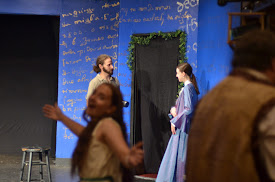
The walls of the stage were painted by Josh using actual text from the time of the play (to symbolize Prospero's books):


First, here is my take on the play.

Act I: 2 scenes.
scene 1: Ariel, unseen but commanded by the magician Prospero, creates an imaginary storm which brings King Alonso’s ship, and all its passengers, to Prospero’s island.
In this scene several characters are introduced: Antonio, Sebastian, Alonso, Gonzalo, the Boatswain and ship Captain (“Master”).
scene 2: Prospero and his daughter Miranda talk about storm and background event (his history, her history, the events leaving to their living on the island for 12 years, and facts about the ship’s passengers). Ariel and Prospero talk and Ariel’s history is given. Caliban is introduced and has a discussion with Prospero, where his background is given; Ferdinand, separated from his father King Alonso by the storm, wanders the island alone and thanks to Prospero’s magic, meets Miranda and they begin to fall in love.

After Act I ends, all the characters but Stephano and Trinculo are introduced and their motivations are (mostly) hinted at.

Act II: 2 scenes.
scene 1: The characters Gonzalo, Alonso, Sebastian, Antonio talk and Gonzalo tried to cheer up Alonso. Their personalities are introduced, with more background; Ariel causes Gonzalo and Alonso to sleep, which Sebastian and Antonio use to plot against their life;, but Ariel saves Alonso's life by waking them at the right instant; Alonso grows very suspicious of them.
scene 2: Caliban, Trinculo, and Stephano and introduced; Caliban drunkenly worships Stephano; Trinculo, and Stephano plan to inherit the island.

After Act II ends, all the subplots are sketched out, all the characters are known, their personalities are introduced, and their motivations are explained.

Act III: 3 scenes.
scene 1: Ferdinand, still separated from his father King Alonso by the storm, talks with Miranda and they discuss their love.
scene 2: Ecouraged by Caliban, Trinculo, and Stephano plot against Prospero’s life; Ariel causes them to fight.
scene 3: Gonzalo, Alonso, Sebastian, Antonio, etc take a rest and envision a magnificent banquet; it vanished suddenly and Ariel gives a long frightening speech warning of their death unless they show sorrow for their past wrongs and promise to lead innocent lives in the future.

After Act III, we see the subplots more fully explored and be better understand Prospero’s scheme of things.

Act IV, 1 scene:
scene 1: Ariel, Prospero, Miranda, and Ferdinand have the “Masque scene”, where spirits sing and their festivities symbolize/bless the upcoming wedding between Ferdinand and Miranda. Caliban, Trinculo, and Stephano further plot against Prospero, but are frightened off by strange noises of dogs and hunters.

Act V, 1 scene:
scene 1: Prospero commands Ariel to get the ship’s passengers together and bring them to her; Prospero casts a spell on them all, Alonso apologies, Prospero forgives all the ships passengers and re-unites Alonso with Ferdinand (now in love with Miranda); the Boatswain reports and the ship is safe and harbored nearby; Prospero gives up his magic and invites all to spend the night and hear the tale of his life on the island, before they depart for Naples the next day.

Epilogue: Prospero asks for the audience’s blessing and freedom with their applause.

Themes of play: power and jealosy, family relationships, forgiveness.

The atmosphere on the set was great. The people are very friendly but professional. I always found the work pleasant, even if it had been a long exhausting day at work. Here are a few shots I took during a break at a tech rehearsal.


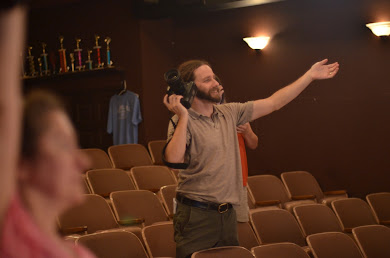
The director, taking pictures of the cast duing a dress rehearsal:


I'm a complete novice to theater work. I might go to a play once or twice a year. As a fifth-grader I starred as the Pauper in "The Prince and the Pauper". I was unable to remember my lines and they had to close the curtain on me. I was not popular with those who had to share the stage with me! Jump ahead 40 years - a year or two ago, I asked someone who was teaching drama if I could hang around for part of a semester while I absorbed all that went on in a student production. I got in the way more than anything. That is my knowledge and experience with plays. With this production I was really surprised the enormous skill and experience that some of the actors had in this production, as well as how much work they put into the play.

Prospero (Kat McKerrow), Miranda (Shelby Hylton) and Caliban (Jeffrey Gangwisch):


Miranda hamming for the camera, the director, and Sebastian (Caity Brown):


Gonzalo (Tom Tomlinson):


Alonso (Penny Martin), Stephano (Marc Rehr) and Maya Wilcox (stage manager/set construction):


The director, Ariel (Diana Taggart), and the Boatswain (David Hill):


The director, Miranda, Prospero and Ariel share a laugh:

It's blown-out but it's also my favorite shot.

I learned a lot. I learned about what a really good director can do to a great play. Josh was excellent, both with the cast and with his knowledge of the material. I also met some terrifically talented actors.
I learned how lighting design works and how to work that particular lighting board. It actually is very easy and very hard at the same time, in a weird way. (Easy to make mistakes as well.) Learning which sliders do which is easy. But the hard part is the "muscle memory" of knowing them well enough that you can work them without mistakes even when you are very tired, the lighting is very low (essentially you are working in the dark most of the time) and how to quickly change from one lighting set-up to the next in time to make the music cues or acting cues on stage.
I also learned Shakespeare's play very well. For me, that was the main thing. To be a better writer, I feel as though I need to learned really great writer's works really well. It was a great experience.

I'll end with an amusing quote. It's not exact, because I don't remember the details or who said it or when, but something like this: An expert on Shakespeare, perhaps a professor of literature, was being interviewed about Shakespeare and said (something like) "You know, in spite of all hype, Shakespeare actually is a very good playwright." I agree:-)

Lighting design notes for "The Tempest"

These are notes for the stage lighting of The Tempest, performed at the Laurel Mill Playhouse, 2012-09-14 thru 2012-09-23, directed by Joshua McKerrow.

The theater is fairly small - with 60 seats for the audience. A diagram of the theater (U is Upstage, D is Downstage, SR is Stage Right, SL is Stage Left) is below:

A picture of the ceiling, taken from upstage center and facing the audience, is here:

Some of the spotlights (or "key" lights) are on, but the floodlights (over the stage) are mostly off.

Here is a picture of the lighting board. The sliders on the lower level controlled the lights:

You can see, for example, that under slider 8, there is a piece of tape with "DSC" written on it. That writing was totally unreadable during a show since the lights were basically turned off (except for a small red bulb) then.


Here is a table describing the lighting board controlling the lights.

slider number function
1 3 reds and 1 yellow (floods)
2 none
3 DSL (= DownStage Left), spotlight
4 r4 whites (floods)
5 none
6 USL, spotlight
7 USR, spotlight
8 DSC, spotlight
9 USC, spotlight
10 DSR, spotlight
11 none
12 4 blues (floods)

Different scenes got different lighting designs. Sometimes these were to punctuate the actors' lines. For example, Ariel's description of the tempest to Prospero (line 317 in Act I scene 2) was accented with some red flashes at the point Ariel said "...I flamed amazement." Other cases were to implement parts of the script (eg, lighting during a storm), or to distinuish the mood of a scene.

To begin, being a complete novice, I read some tutorials. The director, Josh McKerrow, told me he needed a detailed lighting plan written out. I typed up something like this:


Indicated are the lines where a specific lighting plan is to be executed, with a few words of the "cue line" indicated. After getting a reasonably detailed version of this (that the director could use if I could not make a show for some reason) I gave up on this process. I had to create too much shorthand notation and I was constantly correcting my own notes. What I settled on was to buy a book of the screenplay with lots of white space on the page then write in pencil the lighting instructions. Here is an example:

This seemed to work out well. Most of the lighting was really designed by Josh McKerrow, who knew the play much better and had ideas on how he wanted certain scenes light. There were five lighting schemes I named with a special term: "normal" (all keys were on, but the colored lights were not as bright), "storm" (for Act I, scene 1), "Caliban" (which had more blues and reds, and lower key lights), "love scenes" (for Ferdinand and Miranda), the "harpy scene" (Ariel's speech in Act III, scene 3), and "oscillating" (for Prospero's "magic spell" scene in Act V, scene 1). There were other lighting effects, but they were simpler (eg, "set master to level 2", or "USC and DSC only"), so didn't get a name. This naming of lighting schemes made it easier to label the pages of the script, and easier for me to track what lighting changes occurred as the play progressed.

I learned some interesting facts about lighting, but mostly I learned the play really well, thanks to the fact that I could read it over and over, Josh knew it really well, and was happy to talk about it.