Showing posts with label video. Show all posts

2026-03-12

Visualizing Chess Engine Heuristics with Python and Manim

Chess animator

I have recently been developing a Python-based toolset designed to translate chess game data (PGN) into structured video via the Manim animation engine. The project, chess-animator, provides a programmatic framework for visualizing moves alongside underlying evaluation metrics produced by engine analysis.

The package integrates python-chess for logic and Stockfish for centipawn evaluation, generating a multi-panel animation that includes a real-time evaluation bar and comparative metrics for various positional factors.

The source code and documentation are available on GitHub: https://github.com/wdjoyner/chess-animator


Technical Note: Metric Definitions and Scaling

A primary objective of this visualization is to map engine heuristics to an intuitive geometric scale. The evaluation bar and the positional metrics strip follow these specific definitions:

  • Evaluation Bar Scaling: The bar is normalized such that a 100-centipawn advantage (+1.0) corresponds to the height of exactly one square on the adjacent 8x8 chessboard. The visual range is clamped at ±5.0 to maintain resolution for positional play while clearly indicating decisive tactical advantages.
  • Space: This metric quantifies territorial control by counting squares controlled by a side, with higher weights assigned to squares in the opponent's half of the board (ranks 5–8 for White, 1–4 for Black).
  • Mobility: Calculated as the number of legal moves available to a side's pieces, weighted by piece type to reflect the relative importance of activity for different units.
  • King Safety: A structural assessment based on the defensive integrity of the pawn shield and the proximity of friendly versus enemy pieces to the king's square.

By utilizing Manim’s ability to render mathematical objects, these metrics are updated move-by-move in synchronization with the piece animations. This provides a granular view of how the character of a position evolves through the interaction of these heuristics.

Here is an example of the game below

[Event "Candidates Tournament"]
[Site "Toronto CAN"]
[Date "2024.04.04"]
[Round "5"]
[White "Caruana, Fabiano"]
[Black "Nepomniachtchi, Ian"]
[Result "1-0"]
[WhiteElo "2803"]
[BlackElo "2758"]
[ECO "C54"]
[Opening "Italian Game"]

1. e4 e5 2. Nf3 Nc6 3. Bc4 Bc5 4. c3 Nf6 5. d3 d6 
6. O-O O-O 7. Re1 a6 8. Bb3 Ba7 9. h3 Re8 10. Nbd2 Be6 
11. Bc2 d5 12. exd5 Bxd5 13. Nf1 h6 14. Ng3 Qd7 
15. Be3 Bxe3 16. Rxe3 Rad8 17. Qe2 Qc8 18. Rae1 b5 
19. Qd2 Ne7 20. d4 exd4 21. cxd4 Ng6 22. Bb3 Bxb3 
23. axb3 Rxe3 24. Rxe3 Nf4 25. Qc3 Rd5 26. Ne5 N6h5 
27. Nxh5 Nxh5 28. Re1 Nf6 29. Nc6 Qd7 30. Ne5 Qc8 
31. Nc6 Qd7 32. Ne5 1-0

2025-08-18

setting up rithmomachia pieces using patterns

This is a rithmomachia lesson on the ingenious patterns that the values make between the pieces when they are in their initial position, using Blender. Hats off to those extremely clever medieval monks who created this game in the first place over 1000 years ago!

2025-07-11

Meet Professor Pyramid

In up-coming videos, Professor Pyramid
is going to explain something to you, like this:
That's the plan anyway!

2020-04-25

trailer for Russell's Paradox


I made a short "Russell's Paradox" with some friends based on a script I wrote. It was a lot of fun.

Description/Logline: Russell, a contractor, and his wife Bertie, a mathematician, are enjoying a quiet night at home when Russell gets a call from his boss giving him a new job description. Bertie points out a problem with that paradox that Russell didn't predict.

Here's a trailer:


Cast:

Russell - Nick Beschen
Bertie - Alicia Sweeney
Tamika - Carolyn Chun
Director/Editor/Lights - James Angiola
Writer/Editor/Camera - David Joyner
Script supervisor - Susan Snyder
Producer - Annapolis Filmmaking Group

It's been selected as a finalist in the Raw Science Film Festival! Here's a poster, created by James Angiola:

2016-06-08

Selected Balticon 50 writing panels - video

Balticon 50 had a large number of writing panels, a few of which I recorded (by permission).

"Hands on Screenwriting"
Panelists: James Gossard, Clint Gaige
part 1:

"Hands on screenwriting" Balticon panel, part 1 from wdj on Vimeo.

part 2:

"Hands on screenwriting" Balticon panel, part 2 from wdj on Vimeo.


"Adapting your fiction to stage and screen."
Panelists: Izolda Trakhtenberg, Charlie Brown, James Gossard, Clint Gaige
Moderator: David Robison
part 1:

"Adapting your fiction to stage and screen" Balticon panel, part 1 from wdj on Vimeo.

part 2:

“Adapting your fiction to stage and screen” Balticon panel, part 2 from wdj on Vimeo.


"Transmedia on a budget."
Panelists: Clint Gaige, Allison Gamblin, Charlie Brown, James Gossard
Moderator: Pamela Gay
part 1:

Balticon panel on "Transmedia on a budget", part 1 from wdj on Vimeo.

part 2:

Balticon panel on "Transmedia on a budget", part 2 from wdj on Vimeo.


2015-12-29

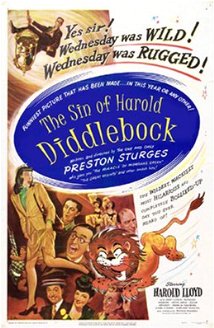
"The Sin of Harold Diddlebock" review

The Sin of Harold Diddlebock (also released as "Mad Wednesday") is a 1947 film written and directed by the great Preston Sturges. It starred Harold Lloyd, Jimmy Conlin and (in a small but important role) Frances Ramsden.

Plot Summary:

A madcap comedy following the ups and downs of Harold Diddlebock.

After scoring the winning touchdown for his college football team mild-mannered Harold Diddlebock (Harold Lloyd), gets a job offer from a football fanatic and business-owner, "Chief". For 22 years, Harold works a dull, dead-end book-keeping job for the man. The story begins with Harold being called into the Chief's office and being fired, with nothing but a tiny pension. Diddlebock bids farewell to the beautiful girl at the desk down the aisle, Miss Otis, whom he had hoped to marry - just as he had hoped to marry six of her older sisters before that. The depressed Diddlebock wanders aimlessly through the streets, his life's savings in hand, and falls in with a con-man Wormy (Jimmy Conlin). They go to a bar for a drink. When he tells the bartender that he's never had a drink in his life, Wormy has the barkeep create a potent cocktail he calls "The Diddlebock". One sip of this concoction is enough to release Diddlebock from all his inhibitions, setting him off on a day-and-a-half binge of spending and carousing. He awakes to find that he has a garish new wardrobe, a ten-gallon hat, a Hansom cab complete with driver, and ownership of a bankrupt circus. Trying to sell the circus to bank owners, Diddlebock and Wormy bring along Jackie the Lion (yes, a real lion, on a leash) to get past the bank guards and presumably to make the point that they do indeed own a circus. The lion incites panic and Diddlebock, Wormy and the lion end up on the ledge of a skyscraper. They are arrested and thrown in jail, but Miss Otis bails them out. Diddlebock learns that the publicity has attracted the Ringling Brothers, who bought their circus for $175,000. Miss Otis also tells him that they got married during his first drinking binge.

Why I Think This Is A Classic 40s Movie:

While not Sturges' greatest film, I think it is a classic due to its zany comedic plot ideas. It was nominated for Grand Prize at the Cannes Film Festival that same year. Harold Lloyd, in comic top form, was nominated for a best actor Golden Globe.

This film brought silent film star Harold Lloyd out of retirement, however, the two apparently had creative differences on set. This was a "collaboration" between Howard Hughes and Preston Sturges. They also had their differences. Hughes did not like the film and the copyright wasn't renewed. It is now in the public domain.

My Favorite Moment In The Movie:

I'm a sucker for sentimental but funny. Check out the film-ending scene with Harold Diddlebock and Miss Otis (now Mrs Diddlebock).


My Favorite Dialogue In the Movie: Harold Diddlebock bids farewell to Miss Otis.

Harold Diddlebock:
Miss Otis, I --

Miss Otis:
Yes, Mister Diddlebock.

Harold Diddlebock:
Miss Otis, when your eldest sister Hortence came to work here
seventeen or eighteen years ago, I fell in love with her. She ws a
lovely girl.

Miss Otis:
Yes, I know, I mean that you fell in love with her. She told me.

Harold Diddlebock:
Well, she swept me off my feet. My circumstances at that time did not permit even the contemplation of marriage.

Miss Otis:
Yes, I know, she told me.

Harold Diddlebock:
She very wisely stopped waiting for me and married the gentleman whose life she has illuminated. I felt that my own life had ended, that I would never love again. That the sunshine would withdraw permanently behind the clouds.

Miss Otis:
Yes, I know.

Harold Diddlebock:
But I was mistaken.

Miss Otis:
Of course.

Harold Diddlebock:
Because when your next eldest sister Ermine came to work here, I fell even more deeply in lve with her that I had with Hortence.

Miss Otis:
Yes, I know, she told me. Hortence even got a little burned about it.

Harold Diddlebock:
Well, she needed have because when Ermine, in her turn, got married she was replaced by your next eldest sister Harriet, I felt that everything that had gone before was merely an appetizer.

Miss Otis:
Yes, I know, she told me too.

Harold Diddlebock:
They were getting better and better. Your mother seemed to be making them nicer every year.

Miss Otis:
Thank you.

Harold Diddlebock:
I haven't come to you yet. ... When Harriet ran away with the head-stone salesman, I was inconsolable.

Miss Otis:
None of us felt very good about it.

Harold Diddlebock:
I was going to propose the very next day.

Miss Otis:
I didn't know that.

Harold Diddlebock:
I had the ring in my pocket. I just made the last payment on it. The one I started for Hortence.

Miss Otis:
You came so close.

Harold Diddlebock:
I never felt so defeated in my life. I never thought I'd smile again.

Miss Otis:
Then you met Margie.

Harold Diddlebock:
That's right. She was better than the others.

Miss Otis:
Mother had more practice.

Harold Diddlebock:
Practice makes perfect. By then, of course, I'd been wiped out in the market.

Miss Otis:
Oh, was that it? She never knew.

Harold Diddlebock:
That's right. I started to get on my feet again when your sister Claire came to work here.

Miss Otis:
Why didn't you ask her? Didn't you like her?

Harold Diddlebock:
Like her? I worshipped her. Only then, that irresponsible lout that married my sister choose that time to kick the bucket, er, pass on, without leaving even a dime's worth of insurance. So, I found myself with a ready-made family.

Miss Otis:
Poor Mister Diddlebock. I suppose you were in love with Rosemary too,
while she was here.

Harold Diddlebock:
Naturally. Of course, I was so in the habit of being in love with your mother's daughters that it would be impossible for me to even see one of them without ... without --

Miss Otis:
Without what, Mister Diddlebock?

Harold Diddlebock:
I presume you know I've adored you since the first morning you punched the time card. ... You knew it, didn't you?

Miss Otis:
Well, I suspected it. My sisters had warned me.

Harold Diddlebock:
Of course. Imagine being exposed to seven Miss Americas and muffing all seven of them.

Miss Otis:
Poor Mister Diddlebock.

Harold Diddlebock:
I'm leaving here today.

Miss Otis:
Oh no, Mister Diddlebock.

Harold Diddlebock:
That's what I really want to tell you. I don't know where I'm going and I very probably won't see you again. Why don't you just take this?

Harold Diddlebock hands Miss Otis a ring box.

Harold Diddlebock:
It's all paid for. Someday when you meet some young man who's really worthy of you, who has everything but the engagement ring, you can take that excuse away from him.

Harold Diddlebock shuffles out.


Key Things You Should Look For When Watching This Movie

The scene between Harold Diddlebock and Wormy when they first meet is brilliant. The final scene with Harold Diddlebock and Miss Otis (now Mrs Diddlebock) is funny and very touching. Look for Sturges' stock company of actors playing the minor roles.

This post also appeared as a guest post on September 2015 in Scott Myers' great Go Into the Story Blog. His blog is the best out there for screenwriting advice. Check it out!

2015-06-15

Making of "The Incompatibles"

This post is a discussion of the making of the video The Incompatibles, an AFG project from wdj on Vimeo.


The video "The Incompatibles" is the first project from the Annapolis Filmmaking Group, a meetup.com group founded by James Angiola. We meet once or twice a month in the Factor's Row restaurant, who have been very generous in giving us meeting space.

James decided to run the group in a workshop fashion, to learn filmmaking by doing. We collected some scripts and decided the first project would be a modification of a public domain script written by Horace Holley in 1916 titled "The Incompatibles".

Next, we did a table read and the group decided that the script needed to be updated in language. I volunteered to take first crack at it but also incorporated suggestions from others. After this, we did another table read where more suggestions were made, and we selected actors (2 male, one female) and crew from the AFG members, and set a date for the shoot. Ultimately, the script ended up as 8 pages. Two other (completely different) revisions were submitted by other members and the plan is they will be made in future meetings.

Before the shoot, the female lead dropped out. Instead of canceling the shoot, I took about an hour out of one morning and rewrote the script without the need of that actor, resulting in a 2 page script. It's just a silly comedy, whcih hopefully some of you find a little amusing. We shot that script using AFG and the edited video is slightly over 3 minutes.

Cast:
* Fred - Benjamin Walker
* George - Attral Platte
* Waitress - Erica Chambers

Crew:
* sound, camera assistant - JT Torres
* director/camera/editor/co-writer - David Joyner

Sources:
* Original script:
Horace Holley "The Incompatibles" (1916)
* Sound track:
Pavel Svimba - Teknikal Problems
license: CC by-nc-sa-3.0

There are problems with the finished edit. I'm not very good at color-correction and it shows, focus was in and out on the waitress (I don't know why), and some coverage was missing. Audio was hampered by my lack of skill at syncing h4n audio to on-camera audio, and the AC running full blast. (This was shot on a hot summer night.) None-the-less, the actors were terrific and, as far as I'm concerned, a fun learning experience! Thanks to everyone involved, including my grand-daughter Addie who lent me her favorite doll for the final shot!

2014-05-29

The GMU Studio A series of videos

Maryland screenwriter Jamie Nash being interviewed at Studio A.
George Mason University has a excellent series of 30 minute videos called Studio A hosted by GMU professor Rick Davis. Here is a listing and short description. Most subjects are people in the film or TV business who live in the VA-DC-MD area, but some are from NY or CA.

Rick Davis and Ann Hornaday on the Studio A set

  1. Studio A: Kathryn O'Sullivan and Paul Awad

    Husband and wife team of director and screenwriter for the western web series, Thurston.
    Good discussion of webseries development.

  2. Studio A: Shanti Thakur

    Shanti teaches at Film Hunter College in NYC. Writes and directs high-concept shorts. Good general discussion of filmmaking in general.


  3. Studio A: Jean-Paul Chreky

    Excellent discussion of a script supervisor's role

  4. Studio A: Melissa Bisagni

    Melissa Bisagni is the Smithsonian Film & Video Center Program Manager. Good discussion of the Native American Indian in film.

  5. Studio A: Lance Kramer

    Lance Kramer co-founded Meridian Hill Pictures, a production company, with his brother. They specialize in documentaries and education. Good discussion of production issues and documentary filmmaking.

  6. Studio A: Erin Essenmacher

    Erin Essenmacher is an award-winning writer, director and producer of docuemhtary films. She serves on the board of directors of Gandhi Brigade and is President of the board of Women in Film and Video, Washington, DC. Excellent discussion of documentary filmmmaking, women in film, indie film.

  7. Studio A: Jamie Nash

    Scriptwriter for "Adventures of a Teenage Dragonslayer", "Altered", and others. Good discussion of nuts and bolts of being a fulltime screenplaywriter. Jamie has partnered a number of projects with Eduardo Sánchez (The Blair Witch Project) and other co-writers. He talks about the co-writing process, the production process form the writers' perspective and about Amazon Studios' model.

  8. Studio A: Tai Burkholder

    Excellent discussion of an executive producers' role, a producers' role, line producer's (also a production supervisor's) role, and a production manager's role.

  9. Studio A: Mark Ruppert

    Ruppert created the 48 Hour Film Project. He got the idea from the already popular 24 hour playwright project. Excellent discussion of creating short films in a short amount of time.

  10. Studio A: Otessa Ghadar

    Otessa Ghadar is the founder and president of new media production company 20/20 Productions. Otessa is most known for her long-running webisode "Orange Juice in Bishop's Garden", which is all about teens growing up/getting down/coming out in the 90s. Great discussion of the production side of making a web-series and connection with social media.

  11. Studio A: Thomas Kaufman

    Tom Kaufman is a award-winning DP, with a lot of documentary and TV experience. (He is also a mystery novel writer.) Excellent discussion of the work of a director of photography.

  12. Studio A: Marc Lieberman

    Marc is a producer and partner with Cavalier Film, and produces for the Onion News Network. Cavelier Films is one of the few production companies with an open submission process. Excellent discussion of indie film business.
    (The audio is way out of sync in this video.)

  13. Studio A: Megan Holley

    Megan is a screenwriter and film editor. Excellent discussion of being an indie screenwriter.
    She has also directed films and discussed aspects of the production pipeline.
    (The audio is out of sync in this video as well.)

  14. Studio A: Estel Dillon

    Videographer, editor, photographer for NBC News for 25+ years. Discusses his experiences as a TV news cameraman.
    (The audio is out of sync in this video as well.)

  15. Studio A: Eric Weissmann

    Eric is an entertainment lawyer in southern California, a so-called "super lawyer." Discusses his experiences as an entertainment lawyer. Lots of funny anecdotes.


  16. Studio A: Peggy Pridemore

    Location manager for many productions, such as Argo, and many of the major films which have a portion of the film shot in DC. Excellent discussion
    of the duties of a location manager in the DC area.

  17. Studio A: Marshall Herskowitz

    Herskovitz was a creator and executive producer of the television shows Thirtysomething, My So-Called Life, and Once and Again, and also wrote and directed several episodes of all three series. He frequently collaborates with Zwick, with whom he runs the film and television production company The Bedford Falls Company. Excellent discussion of TV series writing and production.

  18. Studio A: Angel Sepulveda

    He is a filmmaker who has a lot of experience with music videos. Good discussion of low-budget filmmaking.

  19. Studio A: Michael Gabel

    Michael Gabel is a DC actor with lots of experience in theater, TV and feature film. He describes his experiences as a character actor who works mostly in the DC area.

  20. Studio A: Craig Maniglia

    Craig owns a post-production company. Good discussion of his experiences in running the day-to-day operations.

  21. Studio A: Rob Newcomb

    Rob is a producer, actor, cameraman, filmmaker and GMU alum. He discusses his life and experiences, as well as details of the production side of the business.

  22. Studio A: Dionne Audain

    Dionne is an African-American actor in the DC area, active in theater, TV, and film. Great discussion of her experiences as a DC area actor.

  23. Studio A: Roshini Thinakaran

    Roshini is a journalist and filmmaker, and a GMU graduate. Her documentaries focus on women in war zones.


  24. Studio A: Jon Gann

    Jon is a film festival coordinator, the founder of the DC Film Alliance, and DC Shorts Film Festival, Gann created theGannAgency (marketing and design services) and GannFilms (video and film production) - continuously run commercial enterprises since 1989. Excellent discussion of filmmaking and the film festival in DC.

  25. Studio A: Eric Espejo & Tanner Cooley

    Eric is a film writer/director who is also VP of 19th & Wilson, Inc. a production company in northern Virginia.


  26. Studio A: Jeffrey Cooper

    Jeffrey Cooper is the founder and president of Cut Entertainment Group, an international media sales and film distribution agency. Excellent discussion of the film distribution (sales) agency business (who connect film producers to theatrical distribution company).


  27. Studio A: Eduardo Sanchez

    The co-writer, co-director, producer of The Blair Witch Project talks about his career and ground breaking films. Made for $20K, Blair Witch eventually made $240M. After Blair Witch, Eduardo Sanchez frequently partnered with Jamie Nash (also interviewed by GMU). Excellent discussion of the film business by a Maryland filmmaker.

  28. Studio A: Mark Peterson

    Co-writer of At the Top of the Pyramid (2011)


  29. Studio A: Aaron Peters

    Aaron is a TV writer. Excellent discussion of TV comedy. He has the opinion that breaking into comedy now is easier than before. He suggests if you can make a funny low-budget webseries, which enables you to build a large audience, you will get noticed. Nothing like that was possible years ago.


  30. Studio A: Mimi Machado-Luces

    Mimi is Producer, Writer, Director and president of TVA productions. Excellent discussion of TV production, director and writer, primarily of non-fiction and documentaries programs.


  31. Studio A: Tim Gordon

    Tim Gordon is a DC area film critic and WAFCA chairman. Excellent discussion of films and film criticism.


  32. Studio A: Catherine Wyler

    Film producer (and daughter of William Wyler). Fascinating discussion of life as daughter of a Hollywood legend and as a film producer.


  33. Studio A: Joseph G. Hall

    John is a local area director and producer of short films.

  34. Studio A: Diane Raver

    Diane Raver was the first woman in New York City to own a film production company. Raver is a well-known film producer and the festival director for The Garden State Film Festival. She recently won the 2011 Alice Guy Blache Award. Excellent discussion of the life of a producer, even of commercials.

  35. Studio A: Dennis Boni

    Dennis Boni is an award winning cinematographer working on such projects as the PBS series Journey to Planet Earth. A Steadicam operator for more than 20 years, Boni was one of the few cinematographers handpicked to be trained by Garret Brown, inventor of the Steadicam. Excellent discussion of the life of a DP focusing in the documentary/non-fiction world.

  36. Studio A: Michael Pack

    Michael Pack is a Writer, Producer, and Director for such documentary films as Rediscovering George Washington and Rediscovering Alexander
    Hamilton. Pack is President of Manifold Productions, Inc., an independent film and television production company, founded in 1977. From 2003-2006, he served as Senior Vice President for Television Programming at the Corporation for Public Broadcasting.


  37. Studio A: Kevin McCarthy

    Kevin "BDK" McCarthy is a film critic in the Washington D.C. metro area. He began his movie reviewing career on "The Junkies Morning Show", heard on 106.7 WJFK-FM. He also hosts his own movie show on WJFK. In the summer of 2007, Kevin was hired as the movie reviewer for the Fox affiliate in Washington D.C.


  38. Studio A: Kathleen Jones

    Kathleen Jones has served as Unit Coordinator for Special Units, Field Producer and Associate producer for various programs at National Geographic TV. She is also writer and co-founder of Doc&aDrink, a blog for those hooked on documentaries.


  39. Studio A: Christian D'Andrea

    Christian D’Andrea is credited with co-developing a widely used energy bar for soldiers and civilians alike called SoldierFuel, an idea he came up with while working on HALO: Freefall Warriors, a documentary he created and executive produced for Discovery Communication, LLC networks. D’Andrea is currently producing Searching for God in Iraq, a six-part documentary series examining the presence of religion and the role of chaplains in the U.S. war in Iraq. Please visit storyfoundry.org for more information on upcoming projects.


  40. Studio A: Ron Maxwell

    As an actor, writer, producer, and director, Ron F. Maxwell has a wealth of filmmaking experience. His titles include Little Darlings, Gettysburg, Gods and Generals, and Emmy award- winning Verna: USO Girl. For more information, visit: ronmaxwell.com.


  41. Studio A: Aviva Kempner

    Aviva Kempner is a long time filmmaker whose works have covered a broad range of issues, both domestic and international. The Life and Times of Hank Greenberg is one of her most noted works. She served as the documentary’s writer, director, and producer. Kempner is also the founder of the Washington Jewish Film Festival and the Ciesla Foundation that is dedicated to producing and distributing films to educate the public on social issues of the past and present.

  42. Studio A: Ted Leonsis


    Ted is a very successful and wealthy businessman who has funded some films,
    in particular the documentary film Nanking.

  43. Studio A: Robert Henninger

    Robert L. Henninger is President & CEO of the Arlington, Virginia based Henninger Media Services, Inc. Following a stint as a freelance editor, he founded what was then known as Henninger Video in 1983. In the last twenty-five years, Henninger Media Services, Inc. has grown to become one of the foremost full-service production facilities in the Washington Metropolitan area, having won multiple awards. Please visit henninger.com for more information.

  44. Studio A: Craig MacGowan

    Craig MacGowan is a producer and director with over 35 years of experience in film, television, digital video and audio technology. MacGowan’s most recent documentary, The Face: Jesus in Art, won an Emmy for Outstanding Achievement in Single Camera Photography. He has also lent his talents to the PBS special The Body of Christ in the Art of Europe and New Spain 1150-1800. Please visit: voyagerproductions.com for information.

  45. Studio A: Barry Sisson

    Barry R. Sisson is a businessman turned filmmaker and President of Virginia based independent Cavalier Films. His aim is to merge his business principles with independent film production. His first film project, The Station Agent, went on to win the coveted Audience award at the Sundance Film Festival and was picked up by Miramax Films. Sisson’s second film is Familiar Strangers.


  46. Studio A: Richard Squires

    Richard Squires is an up and coming filmmaker whose recent credits include writer/director of Crazy Like a Fox, a story of a Virginia farmer’s struggles with betrayal and how he chooses to deal with it. The film's stars include Emmy award-winning actor Roger Rees and Academy award nominee Mary McDonnell.


  47. Studio A: Caren Cross

    Caren Cross is a writer/director of documentary films. She wrote and directed the documentary Lost and Found in Mexico.


  48. Studio A: Holly and Paul Fine

    Holly and Paul Fine are a husband and wife team of documentary producer/directors. With over 38 years of experience in the industry, their works have garnered ten National Emmy and 75 Local Emmy awards, as well as three Peabody awards. The couple has had a long association with the CBS news program 60 Minutes and has also produced a number of other television specials including In the Killing Fields of America. After leaving CBS, the Fines signed on with ABC to produce specials for hit series: 20/20, Turning Point, and Primetime Live.

  49. Studio A: Rita McClenny

    Rita D. McClenny is a steadfast advocate of the entertainment industry operating in Virginia. She is the Vice President of Industry Relations
    and Film for the Virginia Film office.

  50. Studio A: Sarah Stein

    Sarah Stein has established her career as an editor and director of documentary films and television. She lent her talents to both Academy
    and Emmy award-winning projects such as The Bolero, Princeton: A Search for Answers, and Chimps: So Like Us, among other critically acclaimed projects.

  51. Studio A: Cuong LeNguyen

    Cuong LeNguyen was a Producer/Director for Arlington Public School in Virginia for which he co-produced and edited the series, Claro! English for Parents, a program geared toward parents for whom English is a second language. He was also the Senior Motion Graphics Designer at Home Front Communications in Washington, DC where he created commercials, PSAs and high-end videos for a wide range of commercial, non-profit, and government organizations. Cuong currently is an independent producer and motion graphics designer developing video content for clients that include Animal Planet, the Bill & Melinda Gates Foundation and the Robert Wood Johnson Foundation


  52. Studio A: Mark Stoeckinger

    Mark Stoeckinger is the sound editor for such films as The Italian Job, Last Samurai, Mission Impossible, and Star Trek.

  53. Studio A: Michael Kang

    Michael Kang is a NY-based writer and director, best known for his films, The Motel and Knots aka Four Wedding Planners.


  54. Studio A: Michael Walter

    Michael Walter is a broadcast journalist turned filmmaker. His documentary film, "Breaking News, Breaking Down" reveals for the first time, how traumatic news events affects those who report them. "Breaking News, Breaking Down" won the 2010 Cannes Best Short Documentary Award.

  55. Studio A: Patricia Hess

    Patricia Doherty Hess has film crew credits for a number of films with her most recent being production manager for Philomena, Night at the Museum:
    Battle of the Smithsonian, Eagle Eye, Get Smart; as well as award winning TV mini-series Angels in America.

  56. Studio A: Ann Hornaday

    Ann Hornaday is a Washington Post film critic.

  57. Studio A: John Kelly

    John Kelly has worked as a freelance Production and Office Assistant for such shows as Law and Order, Gossip Girl, and A Legal Mind. Having
    only been in the field of film and television since graduation from New York University in 2007, John’s views on the industry and how to
    break into the field, offers students a glimpse of what they will face upon their own graduation.

  58. Studio A: Andrew Simpson

    A look into the career of music composer and silent film accompanist, Andrew Simpson.


2014-05-01

Rafael Alvarez on Chaim Potok

In his keynote address to the 2014 Maryland Writers Association Conference, Rafael Alvarez spoke about the "Wisdom of Chaim Potok." Mr Alvarez (and the MWA) kindly allowed his talk to be videoed:


Some brief notes (what I note below is as much the wisdom of Rafael Alvarez and Chaim Potok):
Potok taught writing at JHU in 1996 and allowed Rafael Alvarez, a Baltimore Sun reporter who had not yet published his first book, to sit in. Knowing Potok commuted in my train from Philadelphia, Rafael volunteered to pick him up at the station and drive him to JHU. In this way, he collected the wisdom of Chaim Potok on writing, with the intention of writing an essay on Potok for the Sun. While the essay was never written, this talk is the essay he would have written.

Potok wrote The Chosen, which is a work of literary fiction that sold 3.5 million copies. It was also made into a movie starring Rod Steiger. He wrote about a dozen other books, both fiction and non-fiction, and is highly regarded as a writer of Jewish culture, history and philosophy.

As a teacher at JHU, Potok looks for a students "voice". He also stressed the carpentry, the hard work and the the craft, of writing. Writing is not "won" by the smartest, the most talented, the swiftest. It requires courage and hard work and diligence. Voice can be learned. Keep having new experiences. Don't repeat yourself. Always strive to improve and do better. For a short story, say 10 pages, Potok would write at least a dozen drafts of the overall content and 20 drafts of individual portions. For Potok, the writer is not that different from the sculptor. Both create their works from their imagination - the writer is using the English language and the sculptor a block of marble. However, the writer, Potok says, must first create his marble before he or she can start on crafting the story. It is through the heart and human imagination that we document our stories. We tell ourselves stories in order to live.

For more details of this great lecture, see the video above.

2014-01-19

The making of the short "Beyond the Door"

Beyond the Door is a short film, based on a short story of Philip K. Dick, made with the help of a very talented crew in early 2014. This post explains the evolution.

The story begins with the screenwriting forum, The Black Board, which supports Scott Myers' Go Into The Story blog and the Black List. The BB is a online place where screenwriters meet and talk about films and writing and the screenwriting business. John Muth and I were both involved with the BB, and there we (virtually) met. John and I figured out via the BB that we actually live relatively close to each other, yet for one reason or another never met.

The BB has a thread on generating story concepts, which led me to a search for interesting science fictions stories in the public domain. That's when I found this:


a short called Beyond the Door, by Philip K. Dick. As I think of myself as a beginning student in screenwriting, I assigned an exercise to myself to adapt the story into a script. I quickly wrote a script adaptation and set it aside. Wanting a project to focus on over the winter break, I emailed John asking for advice. He replied very generously offering help, which I jumped at. When I mentioned this adaptation to John Muth as a potential joint project, he loved the idea. I sent him my script, which was about 10 pages. He (politely) tore it apart. I liked his suggestions and rewrote it, and script improved. One thing he talked me out of, and I'm glad he did, was treating Doris as a femme-fatale trope from film-noir. (This perspective on the short story was done already anyway: see Matthew Mandarano's Beyond the Door) This tearing-apart-and-rebuilding process went through numerous iterations, but in the end we have a script that we both feel good about. We met twice to discuss the script and possible test shots during the first week of December, once at my house, where we will be shooting in mid-January 2014, and once at the West restaurant in Annapolis, with some people involved with the Annapolis Film Festival.

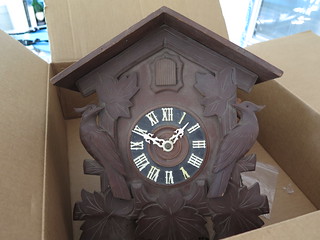
Regarding locations and props, I bought this (non-working) cuckoo clock at the Boonsboro (Maryland) Clock Company, owned and operated by Dave Myers:


The cuckoo comes out of the clock by moving a lever inside the framework of the clock, as this short clip shows.

I made several very crude storyboards


It turns out for various reasons, the seating arrangement with Larry and Doris at the table didn't work, so we switched it so they were sitting together. Most of the other storyboards were used in the finished version.

2013-12-22: great news - I heard from several very talented actors that they are interested in parts in the short. Both Dann Alagna and Jarrett Erwin expressed interest in playing Larry or Bob. Kat McKerrow and Ann Turiano have expressed interest in Doris. (I met Dann and Jarrett and Ann via Liza Skinner. In fact, Liza contacted Dann for me. Dann is a founding member of the acting/improv group Free Range Improv, which Liza belongs to. Liza and Ann are both teachers at the Compass Rose Theater. Kat I know from her performance as Prospero in the Laural Mill performance of The Tempest. Her husband Josh McKerrow directed it and I worked for him as the lighting tech.)


2013-12-24: I wrote up a "production script" detailing about 80 or 90 camera set-ups, and did some test clips, such as this one with the cuckoo clock. I also compiled a props list:

  • cuckoo clock (I bought 2, and an extra cuckoo big for extreme close ups),
  • box and wrapping and tissue paper for clock present,
  • stethoscope, latext gloves and lab coat and body bag for coroner,
  • framed photo of Larry and Doris and child,
  • framed photo of Larry and Doris and bird,
  • robe for Doris,
  • jacket for Bob,
  • empty alcohol bottles,
  • hammer,
  • actors' wardrobe/makeup.

2014-01-02: We had our first rehearsal and it went great.
I'm closest to the camera, then to my left is Jarett Ervin, then Dann Alagna, John Muth, Kat McKerrow, Ann Turiano. The kitty Jeeves is on the floor trying to get attention from someone, anyone. I also did some more test clips, such as this one with Kat McKerrow.

Here is a shot of Larry and the cuckoo:
Our next rehearsal is on the 12th.

I made it clear to the actors that I view the director as no more important than the actors. Sort of like a stage director with a camera. If they have ideas on whether a line should change, or a blocking sequence should be redone, or whether a certain action takes place before or after another, we will try it. This was a team project. They did have several such suggestions and they definitely helped improve the film, thanks to their ideas.

Cast and crew:
  • Actors:
    • Larry: Dann Alagna
    • Doris: Kat McKerrow
    • Bob: Jarrett Ervin
    • Coroner: Ann Turiano
    • Writers: David Joyner and John Muth (based on a public domain story by P. K. Dick)
    • Producers: Liza Skinner, John Muth, Elva Joyner
    • lighting assistant: Charlie Graf
    • assistant production supervisor: Roland McKerrow
    • production assistants: Elva Joyner, Ann Turiano, Dann Alagna
    • Director, Editor, Cinematographer: David Joyner


Books I've enjoyed looking at while in the pre-production/principal photography/post-production process:
  1. Dan Gurskis, The short screenplay, Thompson, 2007.
  2. Steven Katz, Film directing shot by shot, Michael Weiss Productions, 1991.
  3. Bruce Block, Visual story (2nd ed.), Focal Press, 2008.
  4. Jeremy Vineyard, Setting up your shots (2nd ed.), Michael Weiss Productions, 2008.
2014-01-12: We had our second rehearsal and it also went great. Ann and John couldn't make it. The actors decided they preffered to do a run through of all the scenes, even if the wardrobe was wrong and the time of day was wrong. (The porch we were shooting on has no curtains, and is wall-to-wall windows, so day could not pass for night.) We rehearsed for about 3 1/2 hours and quit. I then roughly assembled the shots, with "titles" used as transitions when lines or entire scenes were missed for the actors to view. In all, there were about 120 takes shot that day. Here are some screenshots:


The "real shoot" is next weekend, starting the night of the 18th.

2014-01-19: We are officially in post-production! Barring any re-shoots, I'll try to make all the footage already captured work and avoid re-shooting any scenes, if at all possible. A few hours before the shooting started, a photography friend Charlie Graf helped me set up lighting for the green screen shots, but he had to leave before the actors showed up. The actor playing Doris came down with a virus but agreed to show up anyway for the final scene, which involves all the actors and was difficult to schedule. However, we had to cancel the shoot planned for the 19th. Kat brought her beautiful baby Roland, which my wife Elva kindly sat with to keep him company. Jarrett and Kat left as soon as we shot their scenes. With Ann's help behind the scenes, Dann and I worked late, getting all his solo scenes shot. As usual, it was fun working with all of them but I was exhausted by the time we finally quit shooting.

In all, there were about 90 takes shot that day. The total amount of raw footage was about 25 G, and the total time shooting was about 9 hours. The video from previous week's rehearsal was extremely helpful. Elva spotted lots of problems which helped in the editing (e.g., a mirror catching someone, such as me, that wasn't supposed to be in the shot). Going through the footage from the 18th, I see even more mistakes like that. Hopefully, they are fixable with some extra post-production work. Some shots from the final scene:

From now on, it is working with FCPX, and keeping my fingers crossed:-)

In addition to the script written with John Muth, I started a notebook with more detailed shot descriptions (90 or so in all), and more crude storyboards. I also wrote two drafts of a "production script", the latest of which is here. I decided to interweave into the story the (excellent) 1950 film noir D.O.A., directed by Rudolph Mate which is now in the public domain (in the U.S.).

2014-01-21: I now have the video down to 10:30, not including the end credits.

2014-01-23: After 15 versions of edits, I now have the video down to 9:30, including the end credits.

I'll post the video publicly as soon as I can. I want to submit it to film festivals and am still researching the submission "premiere requirement" criteria for them.

The short is now on imdb: www.imdb.com/title/tt3486714/.

2014-03-12: I learned by email that the short was accepted at the Maryland International Film Festival!

All thanks to my great actors!

2014-05-03: I'm back from the Maryland International Film Festival. A few pics:

  1. Opening night - Peter Breitmayer (actor) and Nathan Marshall (director) of the wonderful and funny Coffee, Kill Boss:
  2. More of the opening night, with a Coffee, Kill Boss Q+A on the main stage:
  3. Daniel Herman (of The Backseat) and Sanj Surati and John Iwasz (of Zombie Casserole), at the Academy Theater on Saturday afternoon, when Beyond the Door was also shown:
More are at this MDIFF flickr album.

2013-04-06

Titans of Newark, at the AFF

I really loved the short narrative Titans of Newark, written and directed by Mike Marino, shown at the 2013 Annapolis Film Festival (AFF).

I wish I could link to a place you could buy it or see it but all I can do is include a short interview I caught on video on the last day of the AFF:

Film Directors Mike Marino and Elizabeth A Lyons from wdj on Vimeo.

Added: The Titans of Newark is now available for free:-)

2012-12-27

making a 5 second video

I took a cinematography workshop at the Baltimore Creative alliance, run by Jeffrey Gangwisch. The CA is located in the Patterson Theater, on Eastern Avenue.


It was a lot of fun and gave me the chance to work with lighting and equipment I haven't handled before. The last class was to film a "5 second video", which we could write ourself. I of course love writing so thought about several ideas. I went through old Non Sequitor comic ideas. The first 5 of the following came from Non Sequitor. The last was motivated by an ad I saw many many years ago, for a college that taught painting. It had the model at an easel painting the painters sitting in front of her.

  1. Deer dressed as St Peter at the gates of heaven.
    Camera on Hunter with shotgun waiting to be admitted.
    Camera pulls back to reveal Deer as he says to Hunter:
    ``Let's just call it karma.''

    props: deer outfit, white robe, hunting rifle, hunters jacket,
    pedital with white and gold cloth draped over it.

  2. Doctor in an office holding an x-ray, patient in gown on examining room table. Doctor says to patient: "You have a severe blockage of your credit rating."

    props: x-ray, patient's gown, doctors lab coat, doctors stethescope, examining table

  3. A panel of people at a table marked "Reality Show Casting", with piles of papers in front of each panelist, marked "Psychos", "Bigots," etc. One panelist reads out loud an application from a normal person (eg, "I work at the family business and like to play scrabble and sing in the church choir ...") and his horrified.

    props: table, signs, lots of papers and manilla folders

  4. Camera shots CU of Dog is lying down on a couch in a psychiatrists office: "bark, yap, bark, yap, ..." Camera pulls back to reveal that the psychiatrist is a Cat.

    props: coach, chair, office furniture, dog outfit, cat outfit

  5. Crowd in art gallery staring and taking about a painting: "I like the artists' use of color." "Reminds me or Picasso." etc. Young Nerd says ``I wonder what software they used for the brush strokes?''

    props: art museum, young nerdy looking actor, crowd of extras

  6. Have scene of actors performing a scene in Romeo and Juliet.
    Juliet: "Romeo, oh Romeo, wherefore art thou Romeo?"
    The person handling Camera A is zooming in and out saying "Zoom" under his breath.
    Director (standing next to Camera A): Camera A. CAMERA A!
    Camera A: Who? Me? What?
    Director: Let's try a medium shot on this one, instead of a zoom. Does everyone agree?
    All: Yes!

    This is caught by Camera B, which shoots the entire scene, cast and crew.

    props: cameras and lighting gear, actors, extras


Jeffrey selected the last one and allowed me to be director. Although I had no idea what I was doing, and Jeffrey had to help out a lot, this was tremendous fun. Here it is (edited by Jeffrey):

Workshop Skit from Jeffrey L. Gangwisch on Vimeo.

2012-10-29

Harrison Demchick’s on Screenwriting

Harrison Demchick gave a screenwriting presentation titled “From Book to Script to Movie” at the Maryland Writers’ Association Conference October 20, 2012 in Baltimore. He won the 2011 Baltimore Screenwriters Competition and has had one of his screenplays optioned. He is the author of forthcoming novel The Listeners (Bancroft Press, 2012) and works as a developmental editor with Writer's Ally, a creative services boutique. For more on Harrison Demchick, see harrisondemchick.com.